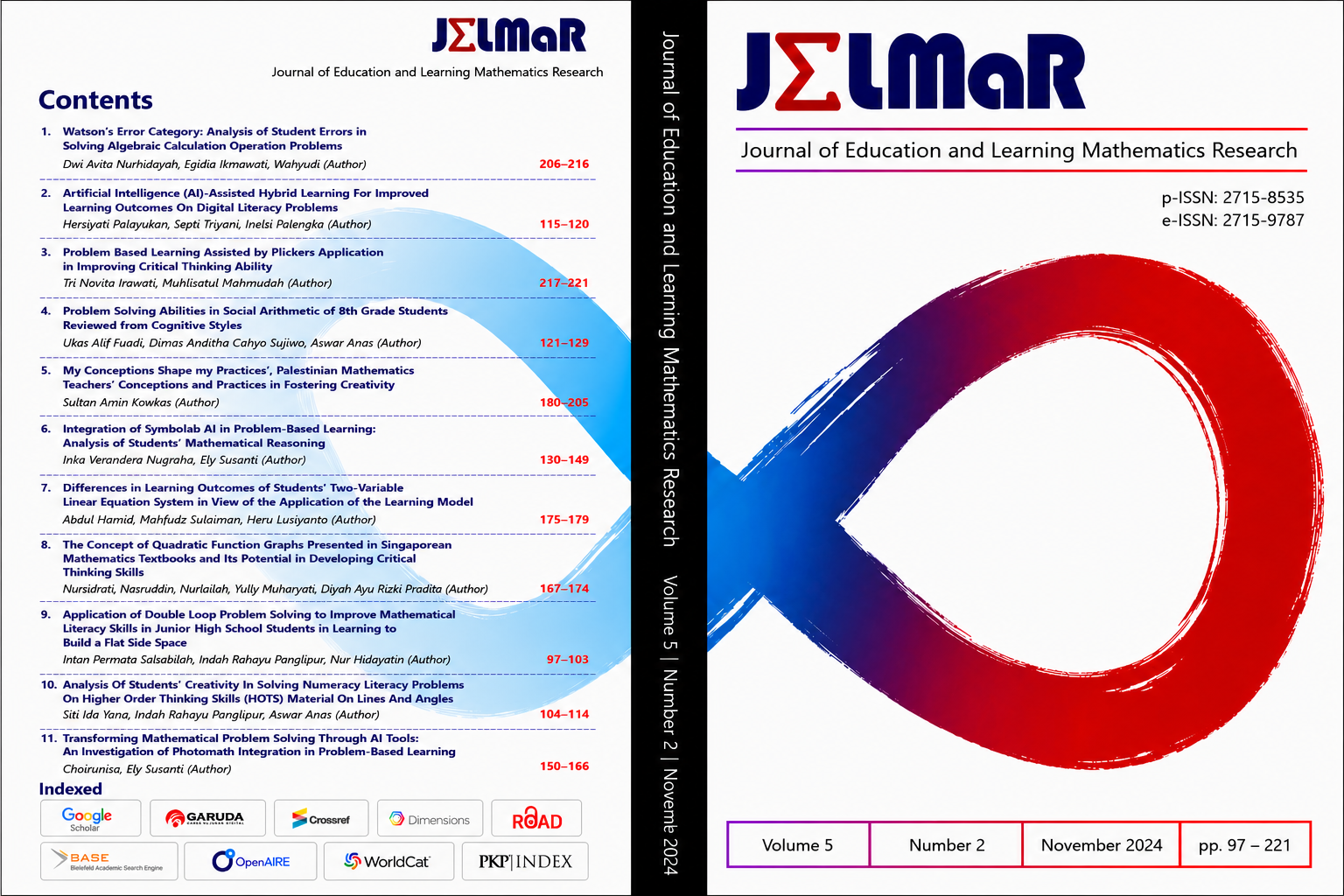
Application of Double Loop Problem Solving to Improve Mathematical Literacy Skills in Junior High School Students in Learning to Build a Flat Side Space
DOI:
https://doi.org/10.37303/jelmar.v5i2.178Keywords:
Mathematical literacy, double loop problem solving, building a flat-sided spaceAbstract
The implementation of learning that tends to be monotonous without paying attention to the active participation of students is one factor contributing to the low mathematical literacy students' skills. The purpose of the study is to explain how to improve mathematical literacy after using the double-loop problem-solving method in learning to build a flat side space. The type of research conducted uses qualitative descriptive with a case study approach. This research was conducted at SMPN 2 Bangsalsari on grade VIII students totaling 8 boys and 7 girls. The data collection technique uses tests, interviews, and observations Interview sheets. observation sheets, and test questions with descriptions are used in the data collection tool. According to the study's findings, both teacher and student activities increased during the course of the study. This is consistent with an increase in the average score for mathematical literacy skills following the introduction of double-loop problem-solving learning. Thus, it very well may be presumed that the use of the twofold circle critical thinking learning model can further develop the numerical proficiency capacity of middle school understudies.
Downloads
References
Angraini, G., & Sriyati, S. (2019). Analisis kemampuan berpikir tingkat tinggi siswa SMAN kelas X di Kota Solok pada konten biologi. Journal of Education Informatic Technology and Science (JeITS), 1(1), 114–124.
Astuti, W., & Kristin, F. (2017). Penerapan model pembelajaran teams games tournament untuk meningkatkan keaktifan dan hasil belajar IPA. Jurnal Ilmiah Sekolah Dasar, 1(3), 155–162.
Farida, R. N., Qohar, A., & Rahardjo, S. (2021). Analisis kemampuan literasi matematis siswa SMA kelas X dalam menyelesaikan soal tipe PISA konten change and relationship. Jurnal Cendekia: Jurnal Pendidikan Matematika, 5(3), 2802–2815.
Farnila, Y. (2016). Efektivitas strategi pembelajaran peer lesson untuk meningkatkan pemahaman konsep bangun ruang sisi datar di kelas VIII MTsN Blangpidie (Skripsi, Universitas Islam Negeri Ar-Raniry).
Hewi, L., & Saleh, M. (2020). Penguatan peran lembaga PAUD untuk Programme for International Student Assessment (PISA). Tunas Siliwangi: Jurnal Program Studi Pendidikan Guru PAUD STKIP Siliwangi Bandung, 6(2), 63–70.
Majid, A. (2017). Analisis data penelitian kualitatif. Aksara Timur.
Makhmudah, S. (2018). Analisis literasi matematika terhadap kemampuan berpikir kritis matematika dan pendidikan karakter mandiri. Dalam PRISMA: Prosiding Seminar Nasional Matematika (Vol. 1, hlm. 318–325).
Murtianto, Y. H. (2013). Pengembangan kurikulum berdiferensiasi mata pelajaran matematika SMA untuk siswa berbakat dan cerdas istimewa di kelas akselerasi (Disertasi doktor, Universitas Sebelas Maret).
Panglipur, I. R., & Mahendra, L. W. E. (2022). Kemampuan berpikir matematis dengan kajian metode pemikiran analogi untuk permasalahan literasi numerasi. Laplace: Jurnal Pendidikan Matematika, 5(2), 434–439. https://doi.org/10.31537/laplace.v5i2.792
Panglipur, I. R., & Putra, E. D. (2018). Analisis pemahaman konsep dasar geometri dengan pembelajaran metode penemuan terbimbing pada mata kuliah geometri. Laplace: Jurnal Pendidikan Matematika, 1(1), 33–40.
Permata, S. A. I., Sunarno, W., & Harlita. (2021). Studi literatur double loop problem solving (DLPS) terhadap kemampuan pemecahan masalah IPA siswa SMP. Inkuiri: Jurnal Pendidikan IPA, 10(2), 108–116.
Pujaastawa, I. B. G. (2016). Teknik wawancara dan observasi untuk pengumpulan bahan informasi. Universitas Udayana.
Rahmawati, N. I., Pratiwi, A. S., Handayani, E., Pratama, M. G. I., & Wahyuni, P. N. (2020). Pengembangan bahan ajar matematika model problem-based learning berbantuan media PowerPoint untuk siswa kelas XI SMK materi barisan dan deret. Dalam Prosiding (hlm. 115–123).
Susanto, A. (2016). Teori belajar dan pembelajaran di sekolah dasar. Kencana Prenada Media Group.
Syapitri, B. (2017). Penerapan model pembelajaran double loop problem solving dalam meningkatkan hasil belajar matematika siswa SMK Muhammadiyah 04 Medan TP 2016/2017 (Skripsi).
Sanjaya, W. (2012). Strategi pembelajaran. Kencana Prenada Media.
Downloads
Published
Issue
Section
License

This work is licensed under a Creative Commons Attribution-ShareAlike 4.0 International License.