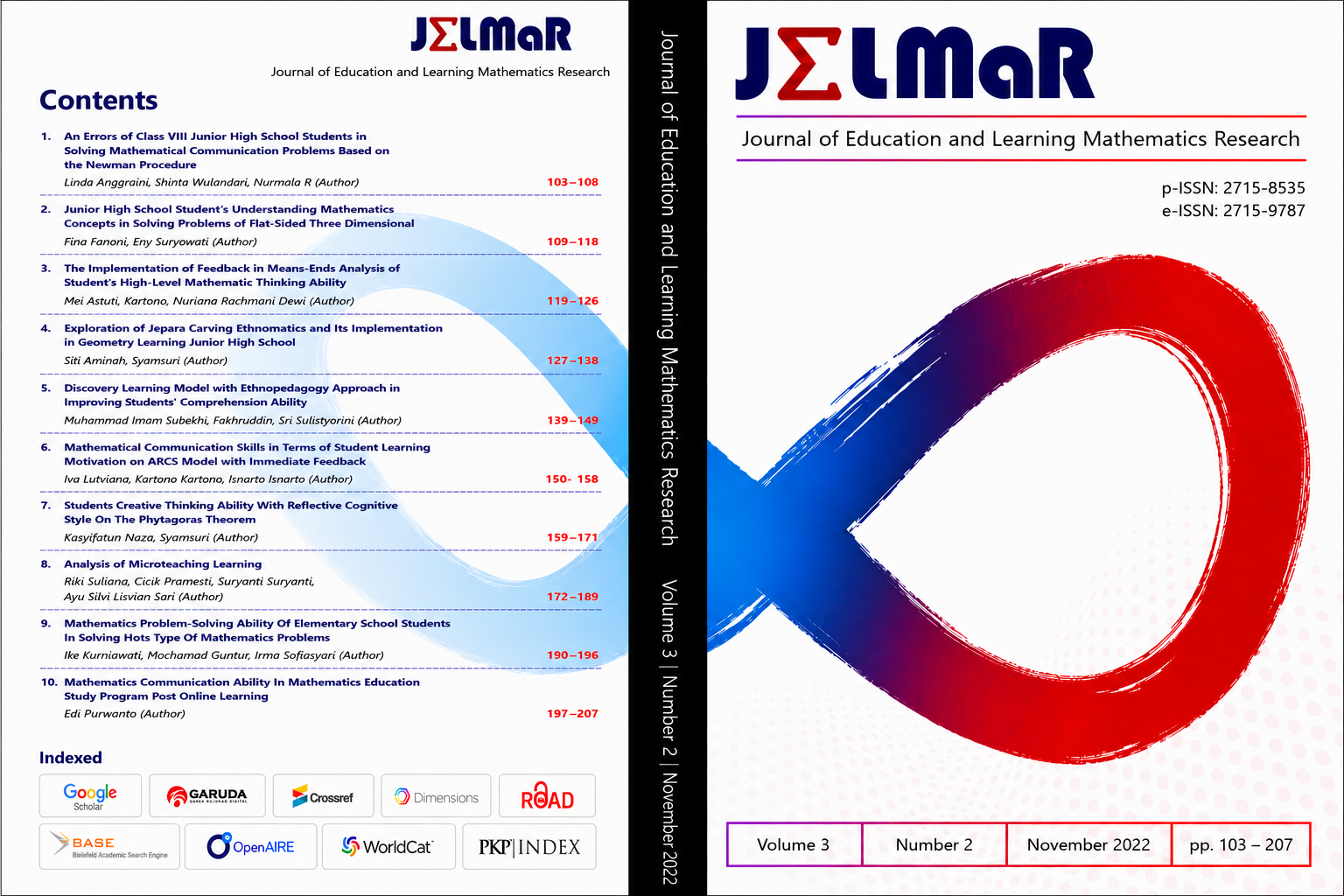
Students Creative Thinking Ability With Reflective Cognitive Style On The Phytagoras Theorem
DOI:
https://doi.org/10.37303/jelmar.v3i2.133Keywords:
creative thinking, cognitive stylesAbstract
Mathematics is a universal science that cannot be separated from human life. Mathematics has an important role in supporting the development of science and technology. In learning mathematics, students' creativity is needed because in mathematics students are expected to be able to come up with new creative ideas in analyzing and solving problems. The way students solve problems will be different according to their cognitive style. So that differences in cognitive styles can trigger differences in students' creative thinking. The type of research used in this research is qualitative research with descriptive method. The subjects in this study were students of class VIII K at SMP Negeri 2 Balaraja who had received the Pythagorean theorem material. Subject selection was done by purposive sampling technique. The instruments used in this study were test and non-test instruments. The test instrument used is the Matching Familiar Figures Test (MFFT) test sheet and the creative thinking ability. While the non-test instrument used in this study was an interview guide. The data analysis of this research used the constant comparative method. Data analysis in this study was carried out through three stages, namely: 1) data reduction, (2) data presentation, (3) drawing conclusions.Based on the results of the data analysis and discussion that has been presented, it can be concluded that based on the reflective cognitive style, students' mathematical creative thinking abilities can be grouped into 2 groups in each indicator with different creative thinking abilities.
Downloads
References
Andianti, T., & Rafianti, I. (2021). Analisis kemampuan berpikir kreatif matematis ditinjau dari self-regulated learning siswa SMP. 2(1), 26–35. (Nama jurnal perlu dilengkapi.)
Bassey, S. W., Umoren, G., & Udida, L. A. (2007). Cognitive styles, secondary school students’ attitude and academic performance in chemistry in Akwa Ibom State, Nigeria. In Proceedings of the EpiSTEME 2 International Conference to Review Research in Science, Technology and Mathematics Education. India.
Fitriana, D. A., & Sudiana, R. (2020). Pengaruh model pembelajaran multipel. 1(4). (Judul artikel dan nama jurnal belum lengkap sehingga perlu diverifikasi.)
Indriati, R. U., Nindiasari, H., & Fathurrohman, M. (2019). Ditinjau dari tahap perkembangan kognitif melalui pembelajaran probing-prompting. 1, 35–46. (Nama jurnal dan judul artikel belum lengkap.)
Kementerian Pendidikan dan Kebudayaan Republik Indonesia. (2013). Kurikulum 2013. Kementerian Pendidikan dan Kebudayaan.
Moleong, L. J. (2007). Metodologi penelitian kualitatif (Edisi revisi). PT Remaja Rosdakarya.
Moleong, L. J. (2010). Metodologi penelitian kualitatif (Edisi revisi). PT Remaja Rosdakarya.
Munandar, U. (1999). Pengembangan kreativitas anak berbakat. Departemen Pendidikan dan Kebudayaan & Rineka Cipta.
Silver, E. A. (1997). Fostering creativity through instruction rich in mathematical problem solving and problem posing. ZDM: The International Journal on Mathematics Education, 29(3), 75–80.
Siswono, T. Y. E. (2005). Upaya meningkatkan kemampuan berpikir kreatif siswa melalui pengajuan masalah. Jurnal Pendidikan Matematika dan Sains, 10(1), 1–9.
Siswono, T. Y. E. (2008). Model pembelajaran matematika berbasis pengajuan dan pemecahan masalah untuk meningkatkan kemampuan berpikir kreatif. Unesa University Press.
Solso, R. L. (1995). Cognitive psychology. Allyn & Bacon.
Sundayana, R. (2016). Media dan alat peraga dalam pembelajaran matematika: Untuk guru, calon guru, orang tua, dan para pecinta matematika. Alfabeta.
Wardani, S., & Rumiyati. (2011). Instrumen penilaian hasil belajar matematika SMP: Belajar dari PISA dan TIMSS. Bumi Aksara.
Warli. (2010). Profile of creativity in reflective and impulsive cognitive style students in solving geometry problems (Tesis). Universitas Negeri Surabaya.
Downloads
Published
Issue
Section
License

This work is licensed under a Creative Commons Attribution-ShareAlike 4.0 International License.