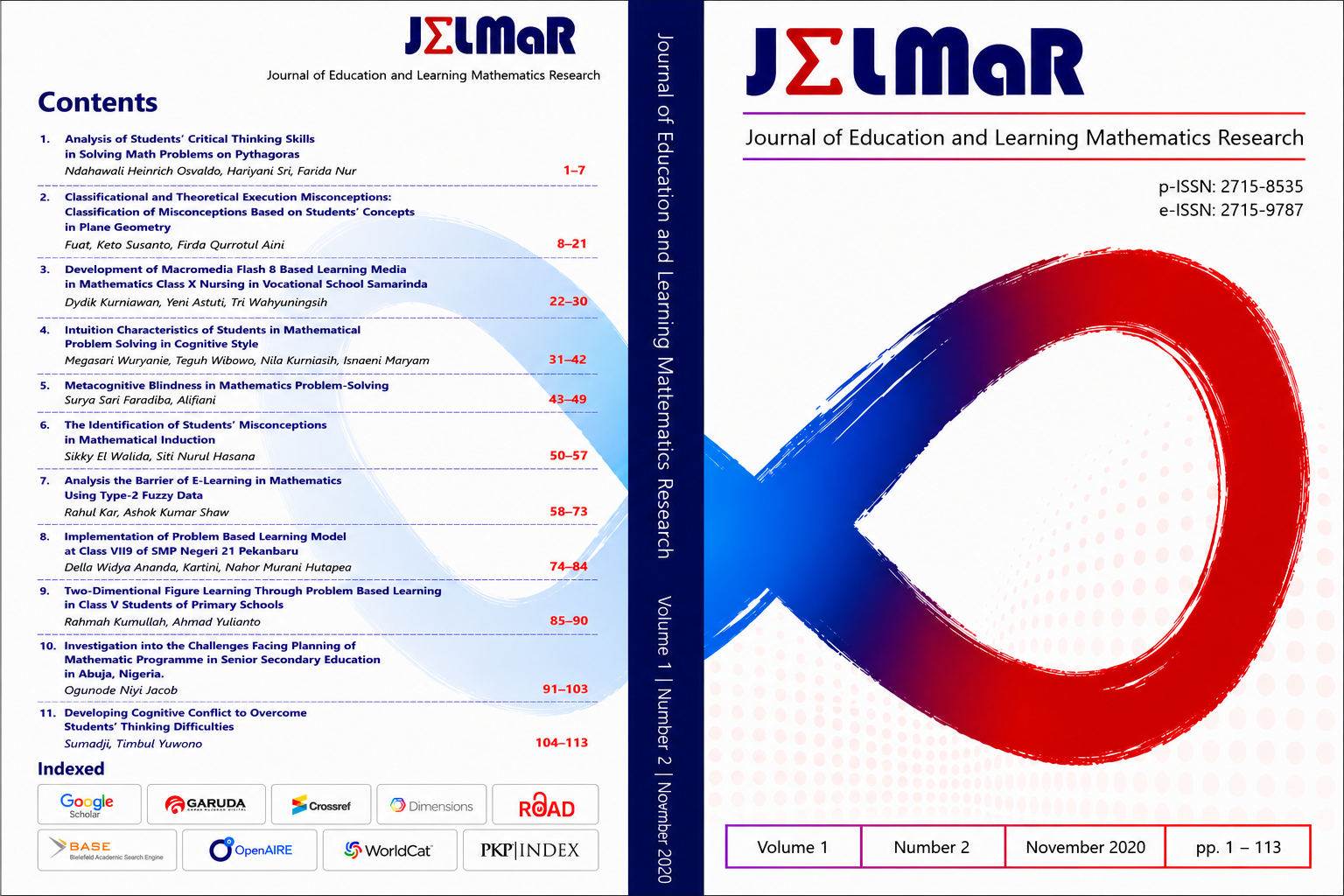
Developing Cognitive Conflict to Overcome Students’ Thinking Difficulties
DOI:
https://doi.org/10.37303/jelmar.v1i2.79Keywords:
Cognitive conflict, thinking difficultyAbstract
The purpose of this study is to describe the thinking difficulties of low-ability students. Low-ability students are those who can only reach score less than 66. The second objective is to know the effectiveness of cognitive conflict strategies in an effort to improve failed cognitive networks. The approach taken is qualitative with the type of classroom action research. In each action, it was applied the group learning strategy in the first session intended to explore additional thinking difficulties. In the second session their difficulties were overcome by implementing a cognitive conflict strategy. This research was completed in two actions based on the amount of material that consists of two parts. The research’s conclusions describe the basic difficulties of students’ thinking but are not summarized here. In this error, mostly students make their own formulas using distributive law on algebra. Another conclusion is that cognitive conflict strategies are effective at the level of 88.6% in overcoming thinking difficulties.
Downloads
References
Asma, N. (2006). Metode pembelajaran kooperatif. Jakarta: Direktorat Jenderal Pendidikan Tinggi, Direktorat Ketenagaan.
Clement, M. N. (2010). Analyzing children’s error on mathematical tasks. Educational Studies in Mathematics, 11, 1–21.
Dahar, R. W. (2010). Teori-teori belajar dan pembelajaran. Jakarta: Erlangga.
Davidson, J. E., & Sternberg, R. J. (2003). The psychology of problem solving. Cambridge: Cambridge University Press.
Djasuli, M., Sa’dijah, C., Parta, I. N., & Daniel, T. (2017). Students’ reflective abstraction in solving number sequence problems. International Electronic Journal of Mathematics Education.
Gür, H. (2009). Trigonometry learning. New Horizons in Education, 57(1).
Hamalik, O. (2010). Kurikulum dan pembelajaran. Jakarta: Bumi Aksara.
Lee, G., & Kwon, J. (2001). What do we know about students' cognitive conflict in science classroom: A theoretical model of cognitive conflict process. In Proceedings of the Annual Meeting of the Association for the Education of Teachers in Science. Costa Mesa, CA: ERIC.
Mason, J., Burton, L., & Stacey, K. (2010). Thinking mathematically (2nd ed.). Harlow: Prentice Hall.
Moody, B. (2010). Connecting the points: Cognitive conflict and decimal magnitude. In L. Sparrow, B. Kissane, & C. Hurst (Eds.), Shaping the future of mathematics education: Proceedings of the Annual Conference of the Mathematics Education Research Group of Australasia (pp. 422–429). Fremantle: MERGA.
Mulyasa, E. (2007). Menjadi guru profesional. Jakarta: PT Remaja Rosdakarya.
Nusantara, T., Subanji, & Susiswo. (2019). Characteristics of students’ cognitive conflict in solving a problem based on information processing theory. International Journal of Learning, Teaching and Educational Research, 18(2), 76–88.
Orton, A. (2002). Learning mathematics: Issues, theory, and classroom practice. London: British Library Cataloguing in Publication Data.
Parwati, N. N. (2008). Pembelajaran persamaan linear satu variabel dengan implementasi strategi konflik kognitif pada siswa kelas I SLTP Laboratorium STKIP Singaraja (Tesis tidak diterbitkan). IKIP Malang.
Pujianto, E., Masykuri, M., & Utomo, S. B. (2018). Penerapan strategi konflik kognitif untuk pembelajaran remidiasi miskonsepsi siswa pada materi kesetimbangan kelas XII MIA SMAN 1 Sukoharjo. Jurnal Pendidikan Kimia, 7(1), 77–85.
Ramlan. (2014). Pemanfaatan strategi konflik kognitif untuk menumbuhkembangkan kemampuan berpikir kritis dalam pembelajaran bangun ruang pada siswa XA SMAN 1 Makassar. Jurnal Matematika dan Pembelajaran, 2(1).
Risnanosanti, R. (2016). Self-efficacy mahasiswa terhadap matematika dan pembelajaran berbasis kegiatan lesson study. Jurnal Elemen, 2(2), 127–136. https://doi.org/10.29408/jel.v2i2.316
Setiawan, W., & Sari, V. T. A. (2018). Pengembangan bahan ajar konsep diferensial berbasis konflik kognitif. Jurnal Elemen, 4(2), 204–218. https://doi.org/10.29408/jel.v4i2.511
Shahbari, J. A., & Peled, I. (2014). Resolving cognitive conflict in a realistic situation with modeling characteristics: Coping with a changing reference in fractions. International Journal of Science and Mathematics Education.
Slavin, R. E. (2012). Cooperative learning: Theory, research, and practice (2nd ed.). Boston: Allyn and Bacon.
Wiranata, A., Tandililing, E., & Oktavianty, E. (2011). Pengaruh strategi konflik kognitif terhadap peningkatan pemahaman konsep pada materi gerak parabola. Pontianak: Program Studi Pendidikan Fisika FKIP Universitas Tanjungpura.
Wiriaatmadja, R. (2005). Metode penelitian tindakan kelas. Bandung: PT Remaja Rosdakarya.
Wyrasti, A. F., Sa’dijah, C., As’ari, A. R., & Sulandra, I. M. (2018). The misanalogical construction of undergraduate students in solving cognitive conflict identification task. International Electronic Journal of Mathematics Education, 14(1), 33–47.
Yusuf, & Munawir. (2003). Pendidikan bagi anak dengan problema belajar. Solo: Tiga Serangkai.
Downloads
Published
Issue
Section
License

This work is licensed under a Creative Commons Attribution-ShareAlike 4.0 International License.