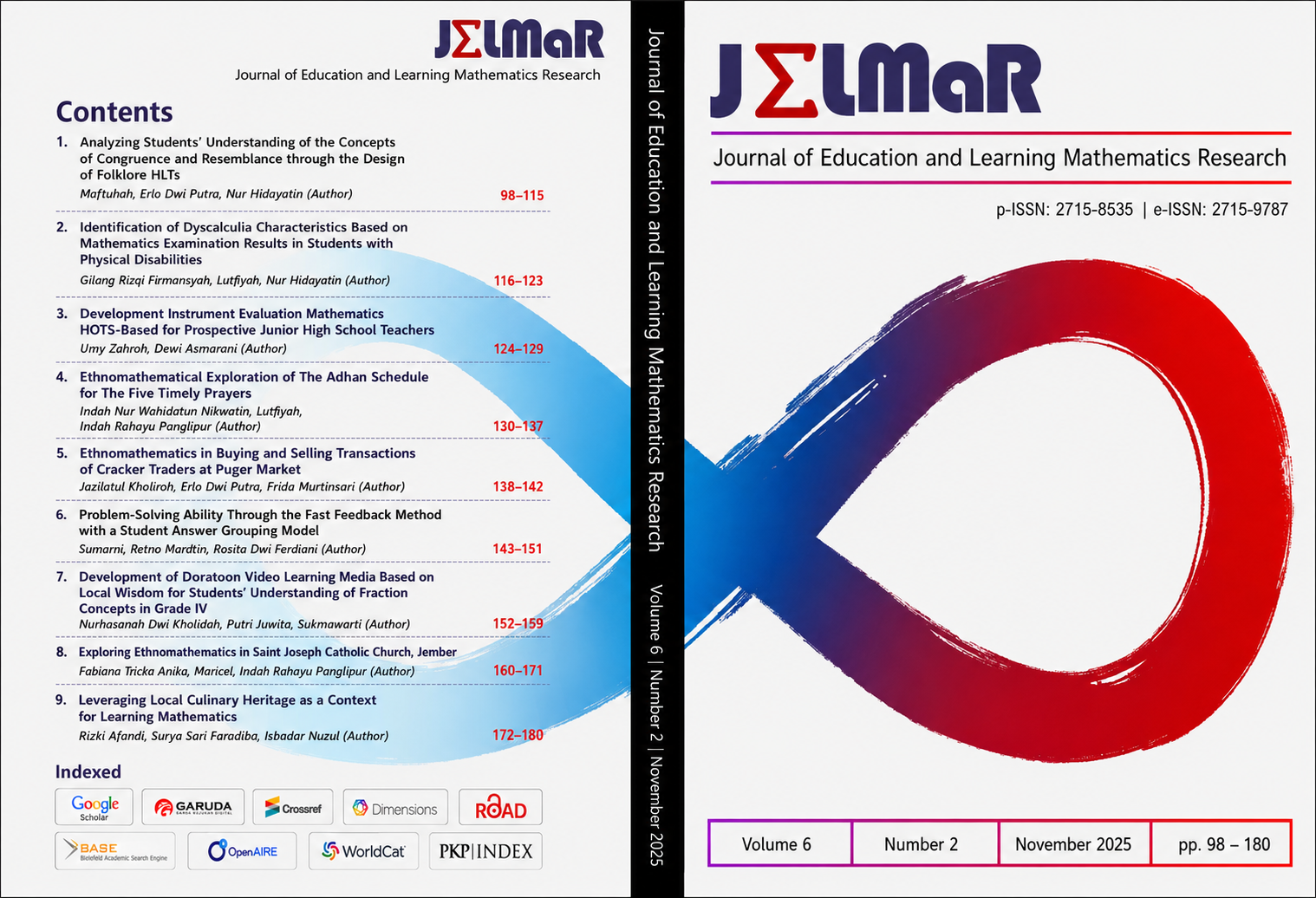
Development Instrument Evaluation Mathematics HOTS-Based for Prospective Junior High School Teachers
DOI:
https://doi.org/10.37303/jelmar.v6i2.3840Keywords:
HOTS, evaluation, mathematicsAbstract
Higher-order thinking skills (HOTS) are essential for meeting the challenges of the 21st century. Therefore, these skills must be possessed by every individual engaged in the learning process. Students, as learners, need frequent practice to develop these skills. To facilitate this, prospective teachers should be capable of designing assessment instruments that foster higher-order thinking. However, in practice, teachers often struggle to create such instruments effectively, as it is a complex task. This study was initiated to address that challenge. It employed a research and development (R&D) approach using the 4D model: define, design, develop, and disseminate. The research subjects were 15 prospective mathematics teachers who developed HOTS-based test items, which were then tested on 79 seventh-grade students at Darul Akhwan International Junior High School. The developed items were evaluated for their validity and practicality through construct and empirical validity tests. The practicality was further assessed using reliability tests, item difficulty levels, and discrimination indices. The results showed that the instrument achieved 100% validity based on expert judgment. The reliability test yielded an rcount = 0.659, which exceeds the rtable = 0.2213; thus, the instrument is considered reliable. The discrimination index analysis revealed that 60% of the items were in the “fair” category, while the remaining 40% were categorized as “good.” Meanwhile, the difficulty level analysis showed that 15% of the items were “very difficult,” 65% were “difficult,” and 20% were “easy.” These results indicate that the instrument has an appropriate level of difficulty. In conclusion, the assessment instrument developed in this study is both valid and practical for evaluating students’ higher-order thinking skills.
Downloads
References
Devi, P.K. (2011). Pengembangan Soal "Higher Order Thinking Skill" dalam Pembelajaran IPA SMP/MTs. Diakses dari https://www.academia.edu/8337926
Dewi, N. P., Rahmi, Y. L., Alberida, H., & Darussyamsu, R. (2020). Validitas dan Reliabilitas Instrumen Penilaian Kemampuan Berpikir Tingkat Tinggi tentang Materi Hereditas untuk Peserta Didik SMA/MA. Jurnal Eksakta Pendidikan (JEP), 4(2), 138–146.
Gunawan, A., Riyadi, A. A., & Musthofa, A. H. (2023). Kompetensi Guru Mata Pelajaran Agama Islam Dalam Meningkatkan Mutu Lulusan Peserta Didik di MTSN 1 Kota Kediri. Jurnal Ilmu Multidisplin, 1(4), 788–798.
Guria, A. (2015). PISA Result in Focus. In PISA 2015.
Ndiung, S., & Jediut, M. (2020). Pengembangan instrumen tes hasil belajar matematika peserta didik sekolah dasar berorientasi pada berpikir tingkat tinggi. Premiere Educandum: Jurnal Pendidikan Dasar Dan Pembelajaran, 10(1), 94. https://doi.org/10.25273/pe.v10i1.6274
Peraturan Menteri Pendidikan dan Kebudayaan Republik Indonesia Nomor 24 Kompetensi Inti dan Kompetensi Dasar Pelajaran pada Kurikulum 2013, Pub. L. No. 24, 1 (2016).
Rahmawati, N. D., Komarudin, & Suherman. (2022). Pengembangan Instrumen Penilaian Matematika Berbasis HOTS Pada Calon Guru Sekolah Dasar. AKSIOMA: Jurnal Program Studi Pendidikan Matematika, 11(2), 860–871.
Safiany, A., & Maryatmi, A. S. (2018). Hubungan self efficacy dan dukungan sosial teman sebaya dengan stres akademik pada siswa-siswi kelas XI di SMA Negeri 4 Jakarta Pusat. IKRA-ITH HUMANIORA: Jurnal Sosial Dan Humaniora, 2(3), 87–95.
Son, A. L. (2019). Instrumentasi kemampuan pemecahan masalah matematis: analisis reliabilitas, validitas, tingkat kesukaran dan daya beda butir soal. Gema Wiralodra, 10(1), 41–52.
Suariantini, N. N. G., Werang, B. R., et al. (2023). Instrumen Asesmen Numerasi Online Menggunakan Aplikasi Kahoot Pada Mata Pelajaran Matematika Kelas IV Sekolah Dasar. Innovative: Journal Of …, 3(2).
Summaries, C. E. (2019). What Students Know and Can Do. PISA 2009 at a Glance, I. https://doi.org/10.1787/g222d18af-en
Downloads
Published
Issue
Section
License
Copyright (c) 2025 Umy Zahroh, Dewi Asmarani (Author)

This work is licensed under a Creative Commons Attribution-ShareAlike 4.0 International License.