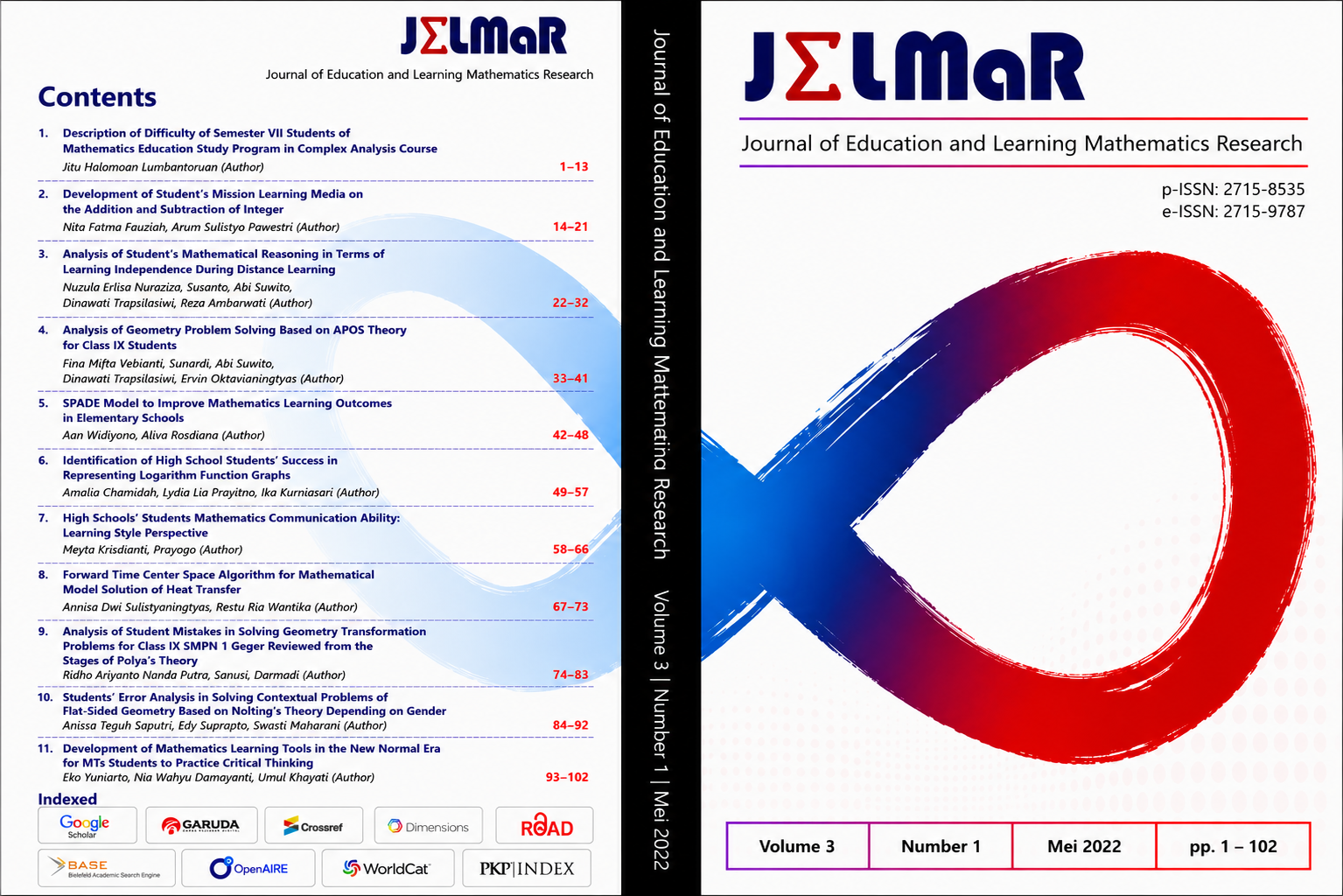
Analysis of Geometry Problem Solving Based on APOS Theory for Class IX Students
DOI:
https://doi.org/10.37303/jelmar.v3i1.108Keywords:
mathematics problem solving, APOS theory, cognitive styleAbstract
This study aims to describe students geometry problem solving abilities based on APOS theory in terms of field dependent and field independent cognitive styles. This type of research is descriptive research with a qualitative approach. The research subjects were 4 students of class IX SMPN 1 Jember which were grouped based on cognitive style, namely 2 students with field independent cognitive style and 2 students with field dependent cognitive style. Methods of data collection using problem solving tests and interviews. The results of data analysis show that FD students tend to be able to write and mention information in questions, but still have difficulty in explaining the meaning of the questions. FI students tend to be able to write and explain information on questions. At the process stage, FI and FD students were able to model and explain the stages well, but FD still had errors in changing the shape of the mathematical model correctly. At the object stage, FI students work on questions freely, while FD students work on questions in detail or fixate on structured steps, FD students also have difficulty explaining their work. At the schema stage, FI and FD students can explain how to use the information in the problem, but FD students still experience errors from the process stage to drawing conclusions as a solution. Field independent students tend to be free or not fixated on complete and detailed steps, while field dependent students tend to be bound or fixated on complete and detailed steps.
Downloads
References
Afgani, M. W., Suryadi, D., & Dahlan, J. A. (2017). Analysis of undergraduate students’ mathematical understanding ability of the limit of function based on APOS theory perspective. Journal of Physics: Conference Series, 895(1).
Alimuddin, R. (2019). Charactheristics of solution of open ended problems reviewed from student cognitive style. Global Science Education Journal, 1(1), 65–72.
Argarini, D., Budiyono, & Sujadi, I. (2014). Karakteristik berpikir kreatif siswa kelas VII SMP N 1 Kragan dalam memecahkan dan mengajukan masalah matematika materi perbandingan ditinjau dari gaya kognitif. Mathematics and Mathematics Education, 4(2), 1–12.
Dubinsky, E. (2001). Using a theory of learning in college mathematics courses. MSOR Connections, 1(2), 10–15.
Heryani, Y., & Ramadani, R. (2019). Analisis kemampuan pemecahan masalah matematis peserta didik berdasarkan gaya belajar model Honey-Mumford. Jurnal Metaedukasi, 1(2), 66–71.
Prabawa, E. A. (2017). Analisis kemampuan pemecahan masalah ditinjau dari gaya kognitif siswa pada model Project Based Learning bernuansa etnomatematika. Journal of Mathematics Education Research, 6(1), 120–129.
Prabowo, A., Usodo, B., & Pambudi, I. (2019). Field-independence versus field-dependence: A serious game on trigonometry learning. Journal of Physics: Conference Series, 1188(1).
Purnomo, R. C., & Sugiarti, T. (2017). Profil kreativitas dalam pemecahan masalah matematika ditinjau dari gaya kognitif Field Independent (FI) dan Field Dependent (FD). Jurnal Edukasi, 4(2), 9–14.
Susanto, H. A. (2015). Pemecahan masalah berdasar gaya kognitif. Deepublish.
Usodo, B. (2011). Profil intuisi mahasiswa dalam memecahkan masalah matematika ditinjau dari gaya kognitif Field Dependent dan Field Independent. Prosiding Seminar Nasional Matematika dan Pendidikan Matematika UNS 2011, 95–172.
Downloads
Published
Issue
Section
License

This work is licensed under a Creative Commons Attribution-ShareAlike 4.0 International License.