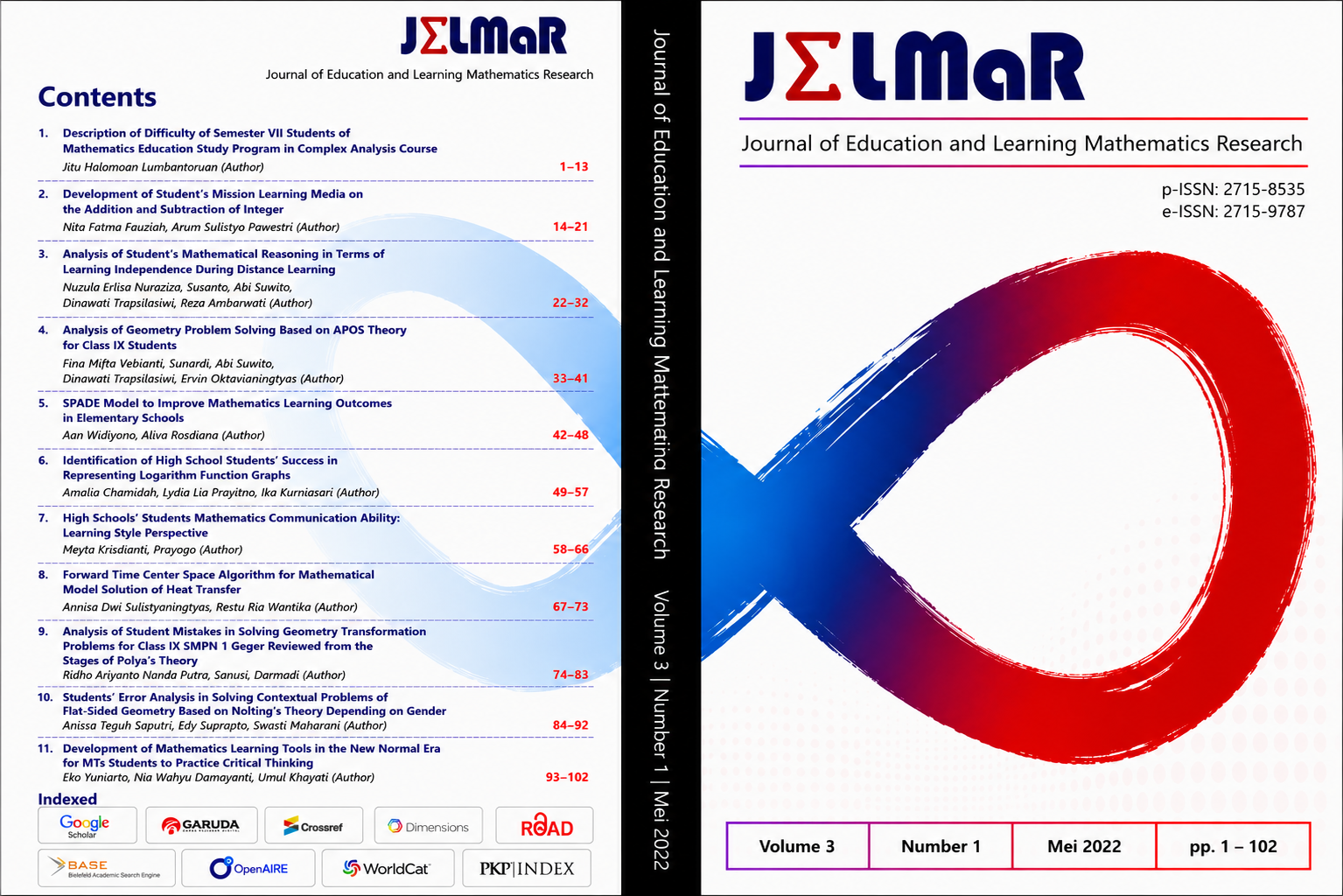
Forward Time Center Space Algorithm for Mathematical Model Solution of Heat Transfer
DOI:
https://doi.org/10.37303/jelmar.v3i1.114Keywords:
Algorithm, Forward Time Center Space, Mathematical Model, Heat TransferAbstract
Heat transfer is a physical phenomenon that can be represented in the form of a mathematical model. In this study, heat transfer occurs in a viscoelastic fluid through an elliptic cylinder surface with free convection flow. The mathematical model of heat transfer is obtained from partial differential equations and solved numerically using the Forward Time Center Space (FTCS) scheme. Numerical solution is carried out based on an algorithm compiled by an iterative process according to a predetermined point. The iteration process is carried out until it produces a stable and convergent value. Furthermore, the algorithm is implemented into the Matlab programming language with the influence of a heat variable, namely the Prandtl number (Pr). Several test results that have been carried out during the iteration process have shown that the FTCS scheme is stable along the space and time grid. In addition, this scheme shows that the obtained difference equations are proven to produce consistent and convergent graphs. Based on the resulting graph, the greater the value of the Prandtl number, the smaller the resulting temperature. This is in accordance with the definition of the Prandtl number, which is the heat determining parameter which is the ratio between the kinematic viscosity value and the heat diffusivity, so that the large Prandtl number can inhibit heat transfer that occurs on the surface of the object.
Downloads
References
Afifah, Y. N., & Putra, B. C. (2018). Model matematika aliran tak tunak pada nanofluid melewati bola teriris dengan pengaruh medan magnet. Teknika: Engineering and Sains Journal, 2(2), 119–124. https://doi.org/10.51804/tesj.v2i2.274.119-124
Annisa Dwi Sulistyaningsih. (2021). Article. 4(1), 44–52. (Data nama jurnal belum tercantum sehingga perlu dilengkapi.)
Cheng, C. Y. (2012). Free convection of non-Newtonian nanofluids about a vertical truncated cone in a porous medium. International Communications in Heat and Mass Transfer. https://doi.org/10.1016/j.icheatmasstransfer.2012.08.004
El Maghfiroh, R., Khusniah, R., & Sholeh, M. (2019). Simulasi numerik perpindahan panas batang baja menggunakan skema beda hingga kompak pada metode Crank–Nicolson. Transformasi: Jurnal Pendidikan Matematika dan Matematika. https://doi.org/10.36526/tr.v3i02.708
Hapsoro, C. A., & Srigutomo, W. (2018). 2-D fluid surface flow modeling using finite-difference method. (Data publikasi belum lengkap, perlu dilengkapi nama jurnal/prosiding, volume, nomor, dan halaman.)
Havid Syafwan, Mahdhivan Syafwan, William Ramdhan, & R. A. Y. (2018). Pemrograman komputasi rumus eksplisit metode beda hingga untuk turunan pertama dengan menggunakan MATLAB. Seminar Nasional Royal (SENAR), September, 61–68.
Imron, C., Suhariningsih, Widodo, B., & Yuwono, T. (2013). Numerical simulation of fluid flow around circular and I-shape cylinder in a tandem configuration. Applied Mathematical Sciences. https://doi.org/10.12988/ams.2013.39490
Kasim, A. R. M. (2014). Convective boundary layer flow of viscoelastic fluid (Doctoral dissertation). Faculty of Science, Universiti Teknologi Malaysia.
Mahat, R., Rawi, N. A., Kasim, A. R. M., & Shafie, S. (2017). Mixed convection boundary layer flow of viscoelastic nanofluid past a horizontal circular cylinder: Case of constant heat flux. Journal of Physics: Conference Series. https://doi.org/10.1088/1742-6596/890/1/012052
Mardianto, L. (2018). Solusi numerik dari aliran fluida magnetohidrodinamik konveksi campuran melalui bola bermagnet. (Data publikasi belum lengkap sehingga perlu dilengkapi.)
Martanegara, H. A., & Yulianti, K. (2020). Model matematika fluida lapisan tipis pada bidang miring. Jurnal EurekaMatika, 8(1), 29–41.
Mohammad, N. F. (2014). Unsteady magnetohydrodynamics convective boundary layer flow past a sphere in viscous and micropolar fluids (Doctoral dissertation). Universiti Teknologi Malaysia.
Pendahuluan, I. (2019). Implementasi algoritma Backward Time Central Space pada penyelesaian model distribusi panas. 9. (Data penulis, nama jurnal, volume, nomor, dan halaman perlu diverifikasi karena tampaknya tidak lengkap.)
Purnami, D., Putri, S., Sukarsa, I. M., Ngurah, G., & Agustika, S. (2018). Analisis kestabilan numerik metode beda hingga pada persamaan getaran membran dan simulasinya. (Data nama prosiding atau jurnal belum lengkap.)
Sahaya, R., Widodo, B., Imron, C., & Matematika, J. (2016). Aliran fluida magnetohidrodinamik viskoelastis tersuspensi yang melewati pelat datar. Jurnal Sains dan Seni ITS.
Tiwow, V. A., Malago, J. D., Fisika, J., Matematika, F., & Alam, P. (2015). Penerapan persamaan Navier–Stokes untuk kasus aliran fluida laminer pada pipa tidak horizontal. IV(1), 51–56. (Nama jurnal perlu dilengkapi.)
Downloads
Published
Issue
Section
License

This work is licensed under a Creative Commons Attribution-ShareAlike 4.0 International License.