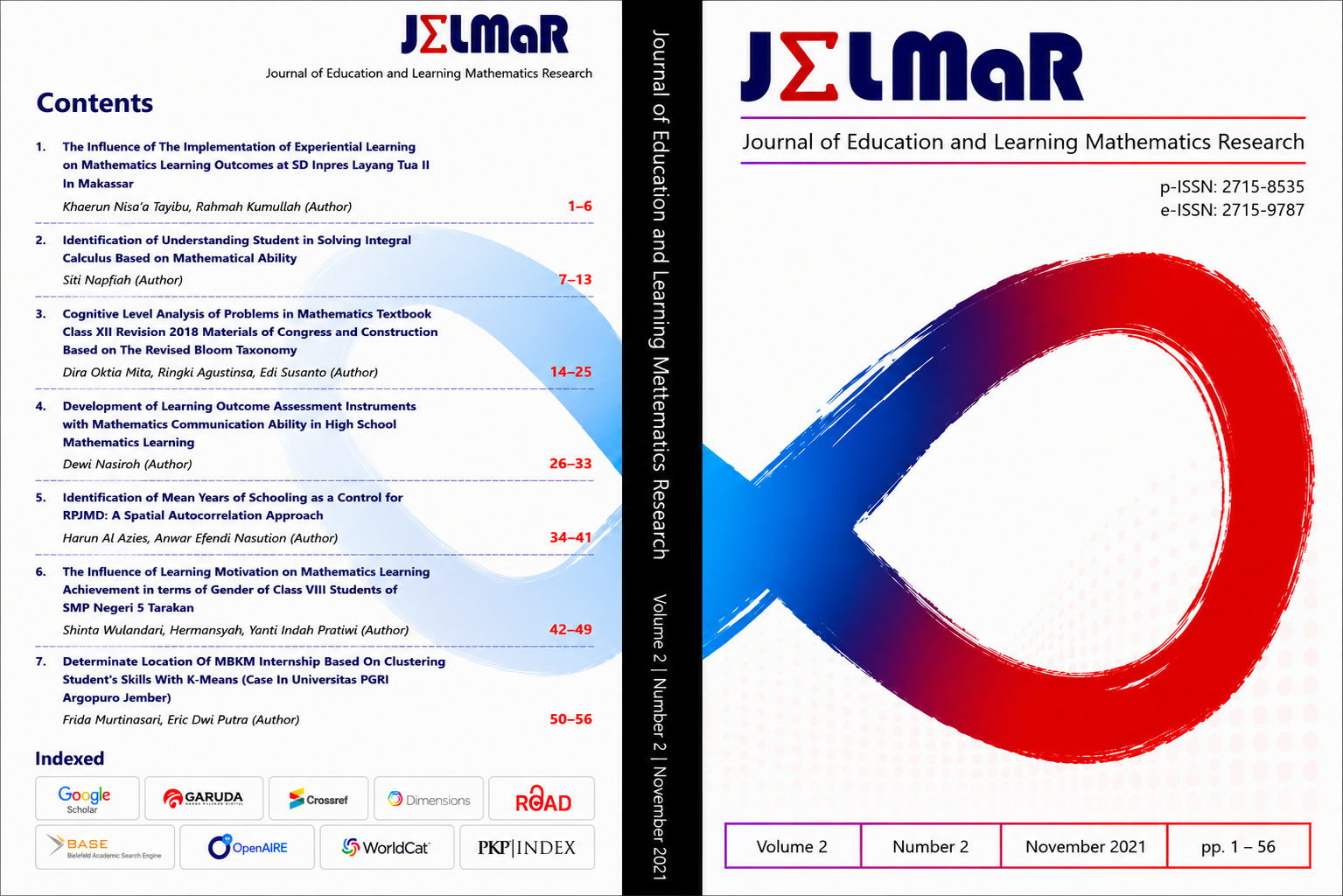
Development of Learning Outcome Assessment Instruments with Mathematics Communication Ability in High School Mathematics Learning
DOI:
https://doi.org/10.37303/jelmar.v2i2.98Keywords:
assessment, instrument, mathematical, trigonometryAbstract
This study (1) develop a learning assessment instrument with the assignment technique-oriented to mathematical communication ability in high school mathematics of trigonometry material (2) reveal the feasibility of the developed instrument, (3) reveal the characteristics of the developed instrument, (4) reveal the users' responses to the instrument, (5) measure the ability of mathematical communication of the students on high school mathematics in learning trigonometry. This study was research and development using the procedure of tests preparation based on Mardapi (2017 ) with the steps including preparing test specifications, writing test questions, reviewing tests, administering tests, analyzing tests items, improving the tests, assembling the tests, administering the tests and interpreting results. The initial product was field-tested to 254 students of high schools in Yogyakarta City. The result of the research was an assessment instrument of learning outcomes with assignment technique-oriented to the mathematical communication ability in high school mathematics learning of trigonometry. The Aiken index was 0.7 for this instrument, and the instrument was reliably tested to a test of participants with the ability ( q ) between -4.07 logits < q <3.79 logits. The teachers' responses to test instruments were good. The results of field trials showed that 20 items fit with the PCM model. The level of difficulty was in the range of -1.29 logits <b < 1.32 logits. The function of the test information Obtained by q = -0.11 logit and the standard error of measurement was 0:18. The measurement result of 90 students shows that the student's mathematical communication ability was 67%.
Downloads
References
Adedoyin, O. O., & Mokobi, T. (2013). Using IRT psychometric analysis in examining the quality of junior certificate mathematics multiple-choice examination test items. International Journal of Asian Social Science, 3(4), 992–1011. Retrieved from https://pdfs.semanticscholar.org/64e2/6548761a8af0c9936d1cf683531e01739a81.pdf
Arikunto, S. (2015). Dasar-dasar evaluasi pendidikan (Edisi 2). Jakarta: Bumi Aksara.
DePascale, C. A., & Dunn, J. (2008). Simplifying psychometrics with SAS. NESUG. Retrieved from https://www.lexjansen.com/nesug/nesug08/ap/ap07.pdf
Istiyono, E., Mardhapi, D., & Suparno. (2014). Penerapan partial credit model pada tes pilihan ganda termodifikasi sebagai model alternatif asesmen fisika yang adil. Dalam Prosiding Konferensi Ilmiah Tahunan Himpunan Evaluasi Pendidikan Indonesia (HEPI) Tahun 2014 (hlm. 115–127).
Kunandar. (2014). Penilaian autentik (Penilaian hasil belajar peserta didik berdasarkan Kurikulum 2013). Jakarta: Rajawali Pers.
Mardhapi, D. (2017). Pengukuran, penilaian, dan evaluasi pendidikan. Yogyakarta: Parama Publishing.
Naga, D. S. (1992). Pengantar teori skor pada pengukuran pendidikan. Jakarta: Gunadarma.
NCTM. (2000). Principles and standards for school mathematics. Reston, VA: National Council of Teachers of Mathematics.
Republik Indonesia. (2003). Undang-Undang Republik Indonesia Nomor 20 Tahun 2003 tentang Sistem Pendidikan Nasional. Jakarta: Pemerintah Republik Indonesia.
Retnawati. (2014). Teori respon butir dan penerapannya. Yogyakarta: Parama Publishing.
Rosnawati, R., Kartowagiran, B., & Jailani. (2015). A formative assessment model of critical thinking in mathematics learning in junior high school. Research and Evaluation in Education, 1(2), 186–198. Retrieved from http://journal.uny.ac.id/index.php/reid
Samejima, F. (1994). Estimation of reliability coefficients using the test information function and its modifications. Applied Psychological Measurement, 18(3), 229–244. Retrieved from https://conservancy.umn.edu/bitstream/handle/11299/117019/v18n3p229.pdf
Samritin, S., & Suryanto, S. (2016). Developing an assessment instrument of junior high school students’ higher order thinking skills in mathematics. Research and Evaluation in Education, 2(1), 92–107. https://doi.org/10.21831/reid.v2i1.8268
Downloads
Published
Issue
Section
License

This work is licensed under a Creative Commons Attribution-ShareAlike 4.0 International License.