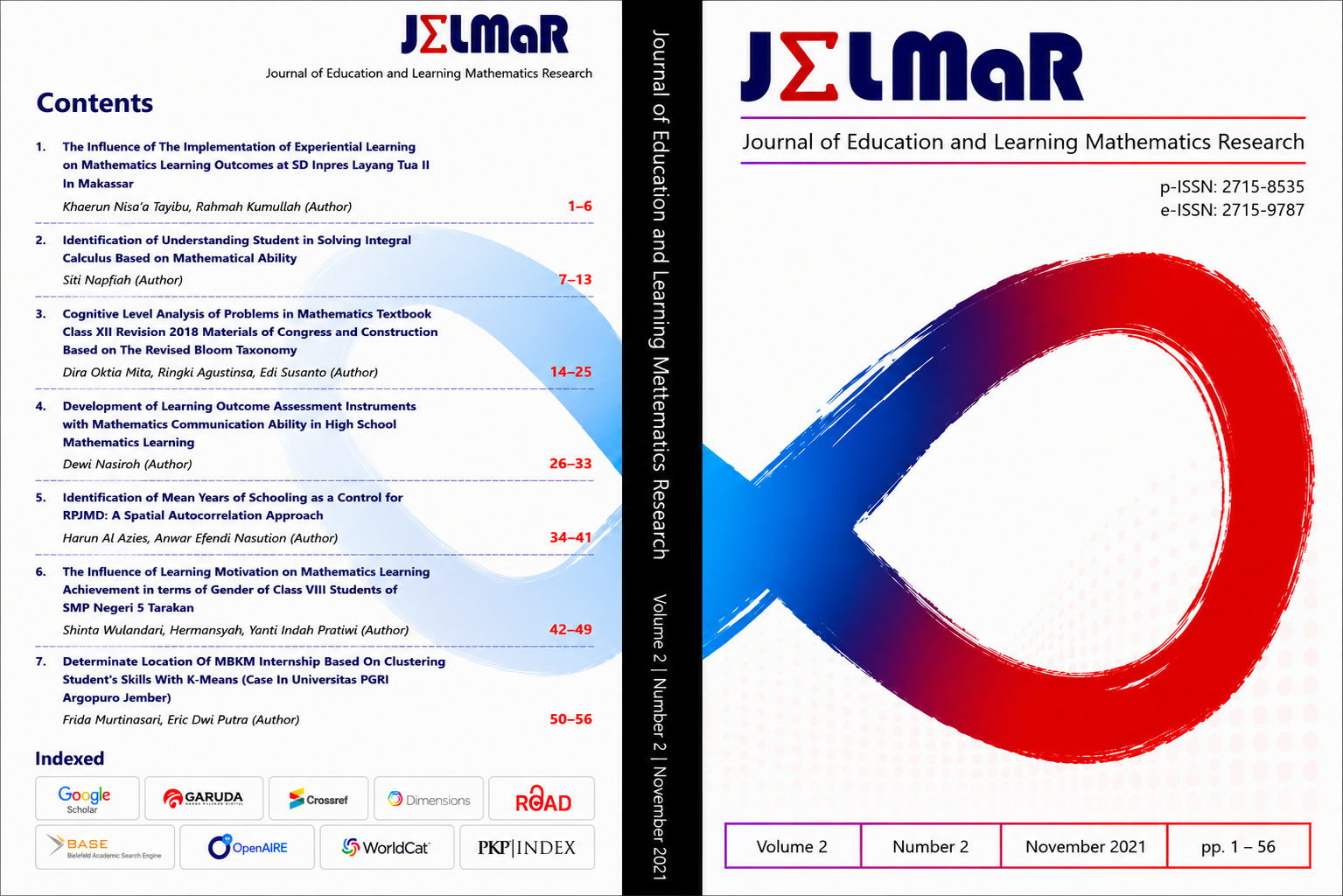
Identification of Understanding Student in Solving Integral Calculus Based on Mathematical Ability
DOI:
https://doi.org/10.37303/jelmar.v2i2.96Keywords:
identification, understanding, integral calculus, mathematics abilityAbstract
The purpose of this study was to identify students' lack of understanding in completing integral calculus based on students' mathematical abilities. Integral calculus material here focuses on the material integration techniques. This material is important to identify the lack of understanding experienced by prospective mathematics teacher students because they muhs be able to mahser this material because this material is found at the secondary school level where they will teach. The research method used is descriptive qualitative method. The research instrument used is an integral calculus question sheet. The data collection technique is done by source triangulation. The data processing technique is carried out by analyzing the results of student work in solving integral calculus problems. The results of the study are described in a narrative manner based on the data obtained. The subjects in this study were two people with high abilities, two people with moderate abilities, and two people with low abilities. Each ability identified their lack of understanding of integral calculus, especially material on integration techniques. Based on the research that has been done, it is concluded that the identification of students' misunderstandings in solving integral calculus problems, especially the material for integration techniques. High ability students can understand the concept of integration techniques. students with moderate abilities can claMSify integration techniques but do not understand the rational function integral techniques. Low-ability students can only understand the basic concepts of integrals but cannot understand the concepts of integration techniques.
Downloads
References
Apriandi, D., & Krisdiana, I. (2016). Analysis of student difficulties in understanding double integral material on polar coordinates for advanced calculus course. Al-Jabar: Jurnal Pendidikan Matematika, 7(2), 123–134. https://doi.org/10.24042/ajpm.v7i2.19
Bien, Y. I., Daniel, F., & Taneo, P. N. L. (2019). Development of Maple-based integral calculus textbooks to improve students' concept understanding. Anargya: Jurnal Ilmiah Pendidikan Matematika, 2(1), 39–45.
Napfiah, S., & Sulihsyorini, Y. (2019). 4K-based calculus learning to improve math problem solving ability. Kalamatika: Jurnal Pendidikan Matematika, 4(2), 193–204. https://doi.org/10.22236/KALAMATIKA.vol4no2.2019pp193-204
Nursyahidah, F., & Albab, I. U. (2017). Investigating student difficulties on integral calculus based on critical thinking aspects. Jurnal Riset Pendidikan Matematika, 4(2), 211–218. http://dx.doi.org/10.21831/jrpm.v4i2.15507
Parma, & Suparwadi, L. (2015). Development of a computer-assisted calculus learning model through the Maple program in the mathematics education study program. Jurnal Elemen, 1(1), 37–48.
Rahayu, Y., & Pujiastuti, H. (2018). Analisis kemampuan pemahaman matematis siswa SMP pada materi himpunan: Studi kasus di SMP Negeri 1 Cibadak. Jurnal Symmetry, 3(2), 93–102.
Ramdani, Y., et al. (2018). The development of instrument and instructional materials of integral concept by scientific debate strategy. Ethos: Jurnal Penelitian dan Pengabdian Masyarakat, 6(1), 1–10.
Sanjaya, F. (2020). Initial ability of integral calculus students of class B mathematics education, Sanata Dharma University. StatMat: Jurnal Statistika dan Matematika, 2(2), 86–94. https://doi.org/10.32493/sm.v2i2.5320
Sholihah, U., & Maryono. (2020). Students’ visual thinking ability in solving the integral problem. JRAMathEdu: Journal of Research and Advances in Mathematics Education, 5(2), 175–186. https://doi.org/10.23917/jramathedu.v5i2.10286
Sugiyono. (2011). Metode penelitian pendidikan: Pendekatan kuantitatif, kualitatif, dan R&D. Bandung: Alfabeta.
Suparwadi, L. (2015). Improving the quality of integral calculus learning through lesson study activities in the mathematics education study program. Jurnal Pendidikan Matematik, 9(1), 35–47.
Utari, R. S., & Utami, A. (2019). Students' concept understanding ability in identifying indeterminate and definite integral problem solving. Jurnal Pendidikan Matematika, 14(1), 39–50. https://doi.org/10.22342/jpm.14.1.6820
Downloads
Published
Issue
Section
License

This work is licensed under a Creative Commons Attribution-ShareAlike 4.0 International License.