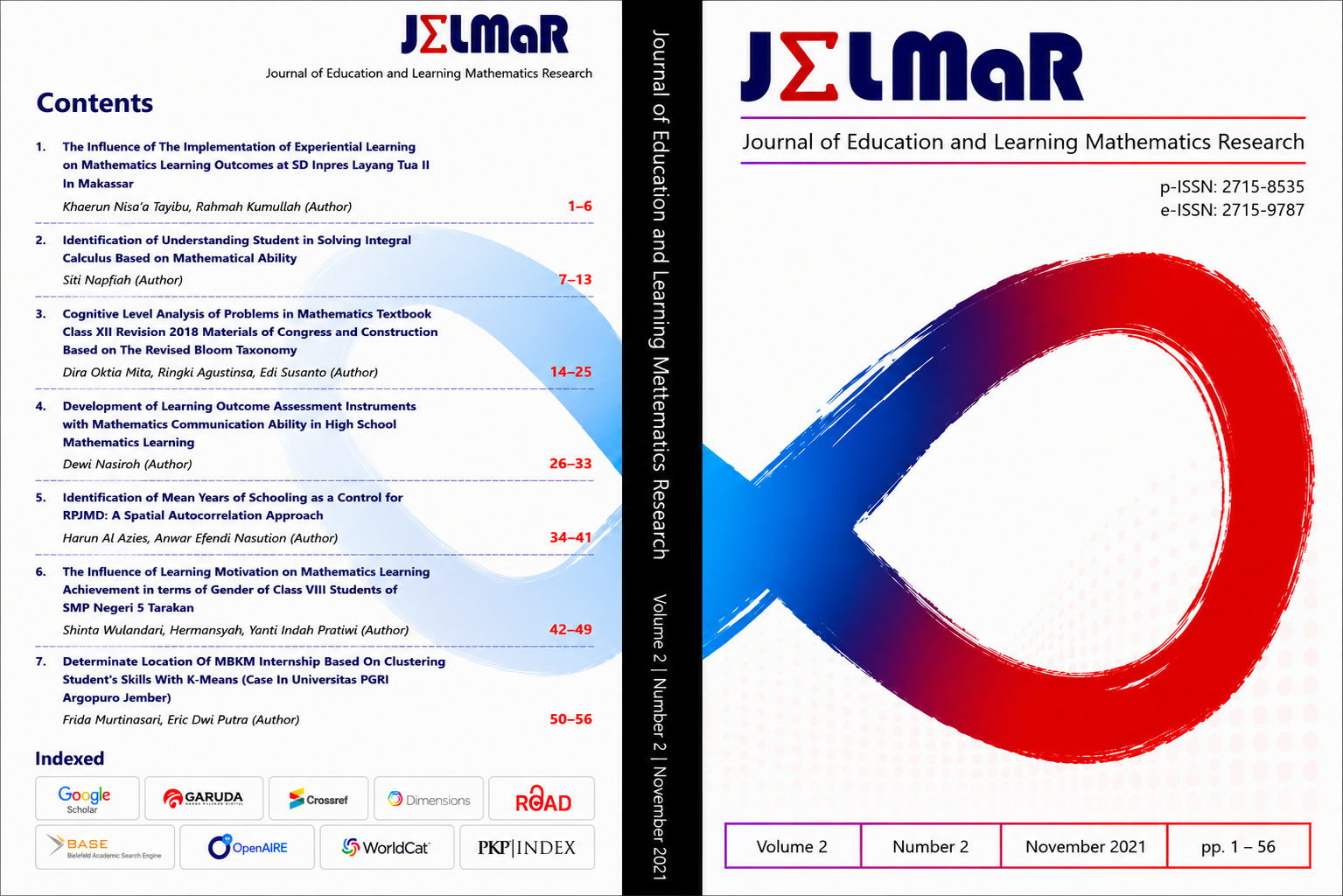
The Influence of The Implementation of Experiential Learning on Mathematics Learning Outcomes at SD Inpres Layang Tua II In Makassar
DOI:
https://doi.org/10.37303/jelmar.v2i2.87Keywords:
Experiential Learning Model, Student Learning OutcomesAbstract
This study aims to (1) know the description of the implementation of the experiential learning model in class V SD Inpres Layang Tua II Makassar City, (2) to know the description of the Mathematics learning outcomes of students of SD Inpres Layang Tua II Makassar City, (3) to determine the effect of implementing the experiential model. learning about Mathematics learning outcomes in students of SD Inpres Layang Tua II Makassar City. This type of research is a true experimental research design involving one experimental class and one control class. The research location is in SD Inpres Layang Tua II, Makassar City. The design of this study was a pretest-posttest control group design. The population of this research is the fifth grade students of SD Inpres Layang Tua II Makassar City with a sample of 20 control classes and 20 experimental classes taken randomly. The independent variable in this study is the implementation of the experiential learning model and the dependent variable is the Mathematics learning outcome. Data collection techniques in this study were tests, observation and documentation. The research instrument was a Mathematics learning outcome test with 23 items and a lesson plan (RPP). The data obtained were analyzed by two types of statistics, namely descriptive statistical tests and inferential statistics including: Data Normality Test, Data Homogeneity Test and Hypothesis Test.The results showed that: (i) the application of the experiential learning model in Mathematics learning for fifth grade students of SD Inpres Layang Tua, Makassar City, which consists of concrete experience stages, observation reflection, abstract concepts and applications generally go well, (ii) Mathematics learning outcomes The fifth grade students of SD Inpres Layang Tua II in Makassar City in the pre-test experimental class were lower than the control class with an average score of 47 for the experimental class and 52 for the control class. Meanwhile, in the post-test the experimental class was higher than the control class with an average score. -The experimental class average is 79 and the control class is 70, (iii) there is an effect of the application of the experiential learning model on the Mathematics learning outcomes of class V SD Inpres Layang Tua II Makassar City after hypothesis testing is 0.004 <0.05.
Downloads
References
Alit, I. M., & Praginda, W. (2009). Hakikat IPA dan pendidikan IPA untuk guru SD. Jakarta: Pusat Pengembangan dan Pemberdayaan Pendidik dan Tenaga Kependidikan Ilmu Pengetahuan Alam (PPPPTK IPA) untuk Program BERMUTU.
Aunurrahman. (2009). Belajar dan pembelajaran. Pontianak: Alfabeta.
Baharuddin. (2007). Teori belajar dan pembelajaran. Yogyakarta: Ar-Ruzz Media.
Bruce, J., & Weil, M. (1980). Models of teaching (5th ed.). USA: Allyn and Bacon.
Bruce, J., Weil, M., & Calhoun, E. (2009). Models of teaching: Model-model pengajaran. Yogyakarta: Pustaka Pelajar.
Coffman, T. (2009). Engaging students through inquiry-oriented learning and technology. USA: Rowman & Littlefield Education.
Degeng, N. S. (1989). Ilmu pembelajaran: Taksonomi variabel. Jakarta: Direktorat Jenderal Pendidikan Tinggi.
Departemen Pendidikan Nasional. (2003). Undang-Undang Republik Indonesia Nomor 20 Tahun 2003 tentang Sistem Pendidikan Nasional. Jakarta: Depdiknas.
Endrayanto, H. Y. S., & Harumurti, Y. W. (2014). Penilaian belajar di sekolah. Yogyakarta: PT Kanisius.
Eshach, H. (2006). Mathematics literacy in primary schools and pre-schools. Netherlands: Springer.
Feasey, R. (2007). Primary mathematics for teaching assistants. New York: Routledge.
Gillespie, H., & Gillespie, R. (2007). Mathematics for primary school teachers. London: McGraw-Hill Open University Press.
Hamalik, O. (2001). Proses belajar mengajar. Jakarta: Bumi Aksara.
Jufri, A. W. (2013). Belajar dan pembelajaran sains. Bandung: Pustaka Reka Cipta.
Komalasari, K. (2013). Pembelajaran kontekstual: Konsep dan aplikasi. Bandung: Refika Aditama.
Kurniasih, I., & Sani, B. (2014). Sukses mengimplementasi Kurikulum 2013: Memahami berbagai aspek dalam Kurikulum 2013. Yogyakarta: Kata Pena.
Manolas, E. I. (n.d.). Kolb's experiential learning model: Enlivening physics course in primary education.
Noor, J. (2010). Metodologi penelitian. Jakarta: Kencana Prenada Media Group.
Peraturan Menteri Pendidikan Nasional Republik Indonesia Nomor 22 Tahun 2006 tentang Standar Isi untuk Satuan Pendidikan Dasar dan Menengah. (2006).
Purwanto, M. N. (1998). Psikologi pendidikan. Jakarta: Remaja Rosdakarya.
Rusman. (2012). Model-model pembelajaran: Mengembangkan profesionalisme guru (Edisi ke-2). Jakarta: PT RajaGrafindo Persada.
Sanjaya, W. (2012). Media komunikasi pembelajaran. Jakarta: Kencana.
Santrock, J. W. (2002). Perkembangan anak (Edisi ke-11, Jilid 1). Jakarta: Erlangga.
Sardiman. (2003). Interaksi dan motivasi belajar mengajar. Jakarta: PT RajaGrafindo Persada.
Slameto. (2003). Belajar dan faktor-faktor yang mempengaruhinya. Jakarta: Rineka Cipta.
Standar Kompetensi dan Kompetensi Dasar Tingkat SD/MI. (2006). Jakarta: Departemen Pendidikan Nasional.
Sudaryono. (2012). Dasar-dasar evaluasi pembelajaran. Yogyakarta: Graha Ilmu.
Sudjana, N. (2005). Penilaian hasil proses belajar mengajar. Bandung: PT Remaja Rosdakarya.
Sugiyono. (2015). Metode penelitian kuantitatif, kualitatif, dan R&D. Bandung: Alfabeta.
Suprihatiningrum, J. (2013). Strategi pembelajaran: Teori dan aplikasi. Yogyakarta: Ar-Ruzz Media.
Suyono, & Hariyanto. (2012). Belajar dan pembelajaran: Teori dan konsep dasar. Bandung: Remaja Rosdakarya.
Syah, M. (2008). Psikologi pendidikan dengan pendekatan baru. Bandung: Remaja Rosdakarya.
Wahap, A. A. (2009). Metode dan model-model mengajar (Cetakan III). Bandung: Alfabeta.
Winkel, W. S. (1989). Psikologi pengajaran. Jakarta: Gramedia.
Downloads
Published
Issue
Section
License

This work is licensed under a Creative Commons Attribution-ShareAlike 4.0 International License.