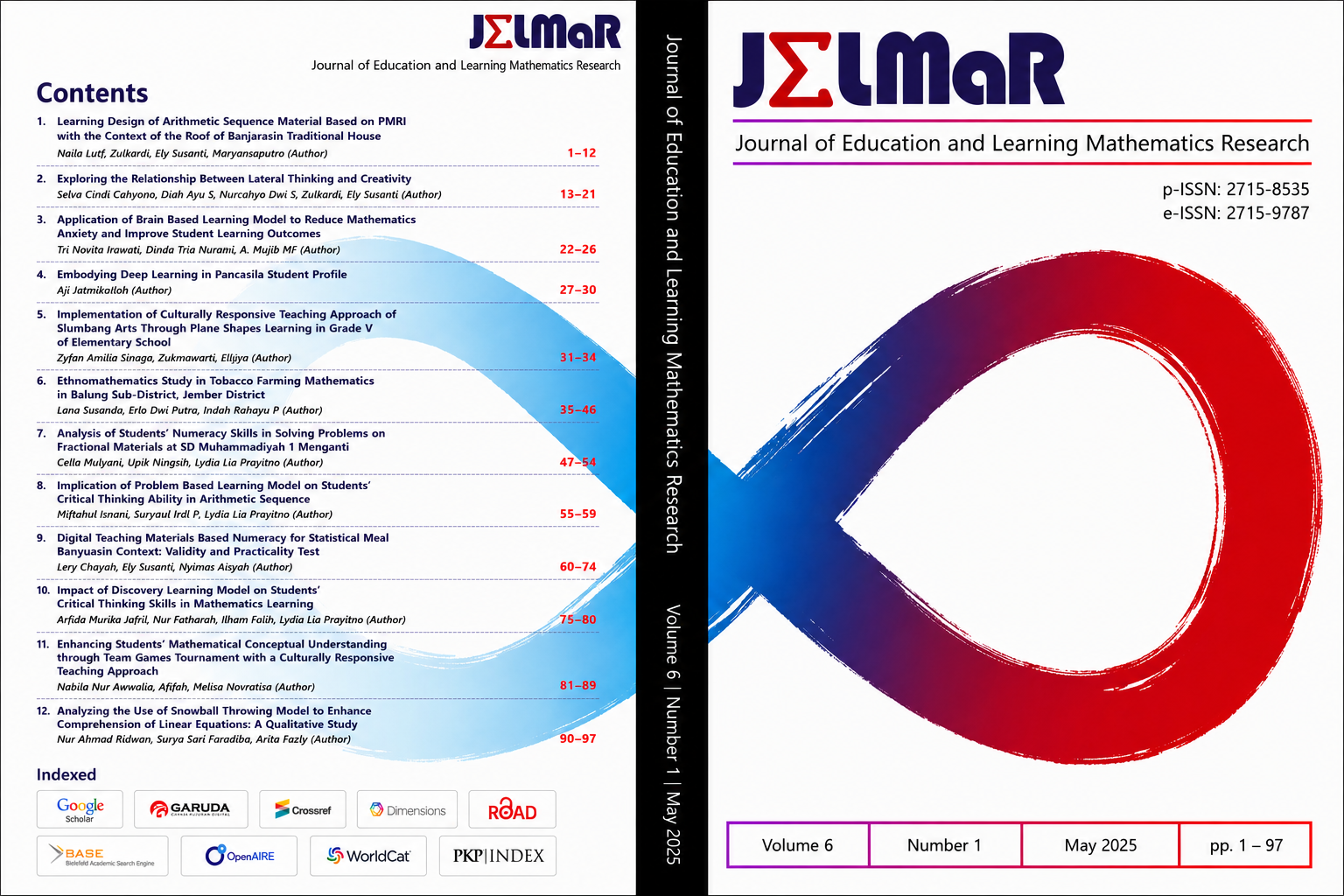
Application of Brain Based Learning Model to Reduce Mathematics Anxiety and Improve Student Learning Outcomes
DOI:
https://doi.org/10.37303/jelmar.v6i1.3817Keywords:
brain based learning, learning outcomes, mathematics anxietyAbstract
Mathematic anxiety and low student learning outcomes are problems that need special attention, especially in the field of mathematics learning. The purpose of this study is to reduce students' mathematic anxiety level and improve their learning outcomes by applying the Brain Based Learning model. This type of research uses Classroom Action Research which consists of 2 cycles, namely planning, implementation or action, observation or observation, and reflection. The data collection techniques used were interviews, questionnaires, observations, tests, and documentation. The results of this study prove a decrease in students' mathematics anxiety, where in cycle I 10 students experienced high anxiety, while in cycle II there were no students who experienced high anxiety. In addition, student learning outcomes also increased from 63.64% including the sufficient category in cycle I, then in cycle II to 87.88% with a very good category. So this research proves that using the Brain Based Learning model can reduce mathematics anxiety and improve their learning outcomes.
Downloads
References
Arikunto, S. (2021). Penelitian Tindakan Kelas: Edisi Revisi. Jakarta: Bumi Aksara.
Fikriyah, D. S., Maharani, G., Nugraha, M. G. A., & Mubarika, M. P. (2021). Meningkatkan Kemampuan Pemahaman Serta Menurunkan Kecemasan Matematis Melalui Strategi Brain Based Learning. JUMLAHKU: Jurnal Matematika Ilmiah STKIP Muhammadiyah Kuningan, 7(2), 64–78.
Hasyim, P. H., & Abadi, A. P. (2023). Pengaruh Motivasi Belajar terhadap Kemampuan Pemahaman Matematis Siswa. MATH LOCUS: Jurnal Riset dan Inovasi Pendidikan Matematika, 06(01), 4877–4883. https://doi.org/10.31002/mathlocus.v4i2.4238.
Laily, N., & Lestari, A. S. B. (2024). Studi Literatur: Analisis Pembelajaran Matematika Kecemasan Siswa pada Pembelajaran Matematika. Ar-Riyadhiyyat: Jurnal Pendidikan Matematika, 4(2), 81–89.
Permana, F. B., & Sulastri, A. (2020). Pendekatan Brain-Based Learning sebagai Model Pembelajaran di Sekolah Dasar. Jurnal Basicedu, 8(4), 3322–3330. https://doi.org/10.31004/basicedu.v8i4.8544.
Profithasari, N., Lutfiani, U. I., & Rapani. (2024). Efektivitas Brain Based Learning Berbantuan Wordwall terhadap Kemampuan Berpikir Kritis Peserta Didik. Jurnal Studi Guru dan Pembelajaran, 7(1), 399–408. https://doi.org/10.30605/jsgp.7.1.2024.3841.
Sholichah, F. M., & Aini, A. N. (2022). Math Anxiety Siswa: Level dan Aspek Kecemasan. Journal of Mathematics Learning Innovation (JMLI), 1(2), 125–134.
Susanto, A. (2018). Bimbingan dan Konseling di Sekolah: Konsep, Teori, dan Aplikasinya. Jakarta: Prenadamedia Group.
Wahyudi, H., Irawati, T. N., & Siskawati, F. S. (2021). Penerapan Model Pembelajaran TAI Berbasis PBI untuk Meningkatkan Aktivitas dan Hasil Belajar Matematika. AXIOMA: Jurnal Matematika dan Pembelajaran, 6(2), 78–86.
MT, A. M. (2022). Peningkatan Kualitas Mahasiswa Pendidikan Matematika Melalui Pelatihan Pemanfaatan Mobile dalam Pembelajaran Matematika. Al-Khidmah Jurnal Pengabdian Masyarakat, 2(1), 41–48. https://doi.org/10.56013/jak.v2i1.1423.
Wijayanti, A., & Yanto, A. (2023). Pembelajaran Matematika Menyenangkan di SD Melalui Permainan. Polinomial: Jurnal Pendidikan Matematika, 2(1), 18–23. https://doi.org/10.56916/jp.v2i1.316.
Wuisan, S., Tuerah, P. E. A., & Tilaar, A. L. F. (2024). Analisis Tingkat Mathematics Anxiety dan Tingkat Self-Efficacy terhadap Prestasi Belajar Matematika Siswa SMP. 4(1), 554–564. https://doi.org/10.51574/kognitif.v4i1.1662.
Zanabazar, A., Deleg, A., Ravdan, M., & Tsogt-Erdene, E. (2023). The Relationship Between Mathematics Anxiety and Mathematical Performance Among Undergraduate Students. Jurnal Ilmiah Peuradeun, 11(1), 309–322. https://doi.org/10.26811/peuradeun.v11i1.780.
Downloads
Published
Issue
Section
License
Copyright (c) 2025 Tri Novita Irawati, Dinda Tria Winarsih, A. Mujib MT (Author)

This work is licensed under a Creative Commons Attribution-ShareAlike 4.0 International License.