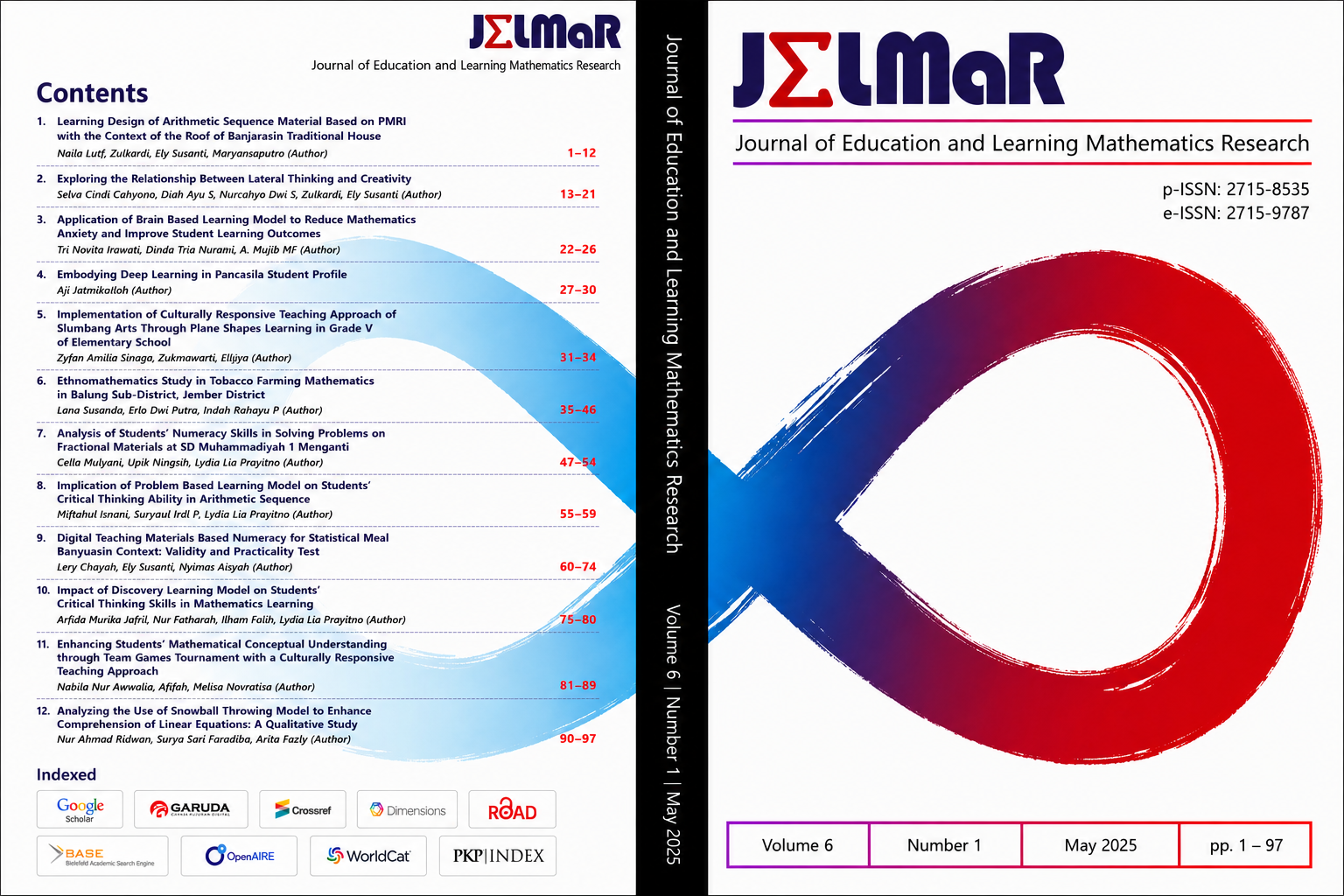
Digital Teaching Materials Based Numeracy for Statistics Musi Banyuasin Context: Validity and Practicality Test
DOI:
https://doi.org/10.37303/jelmar.v6i1.3829Keywords:
numeracy skills, development, digital teaching materialAbstract
Numeracy skills can be supported by the use of digital teaching materials. One of them is digital teaching materials designed to support thinking skills to improve concentration and problem solving, with interesting features such as videos, images, and texts by only utilizing links and tools available on students’ Android mobile phones. This study aims to produce valid and practical digital teaching materials and describe students’ responses after using the digital teaching material. The subjects of this study were 24 students of grade VII of SMP Negeri 4 Jirak Jaya. This research procedure uses a research design based on the Plomp development model. The Plomp development procedure consists of 4 phases, namely preliminary study, design phase, realization phase, and test, evaluation and revision phases. Data collection techniques used are questionnaires, observations, documentation, and interviews. Questionnaires are used to assess the validity and practicality of digital teaching materials. Observations are used to measure the effectiveness of learning. The data analysis technique used in this study is descriptive, both quantitative descriptive and qualitative descriptive. Based on the results of data analysis, it was obtained that the developed digital teaching materials fall into the valid category when viewed from the aspects of content, construction, language, and ICT. In addition, numeracy-based digital teaching materials also fall into the practical category when viewed from the aspects of ease of use, attractiveness, challenges, and their application in mathematics learning.
Downloads
References
Aisyah, A., & Juandi, D. (2022). The Description of Indonesian Student Mathematics Literacy in the Last Decade. International Journal of Trends in Mathematics Education Research, 5(1), 105–110. https://doi.org/10.33122/ijtmer.v5i1.114.
Ati, S. N. T. K. (2018). Teaching Materials Teaching Materials Teaching Materials. Repository.UPY.
Bolstad, O. H. (2023). Lower Secondary Students' Encounters with Mathematical Literacy. Mathematics Education Research Journal, 35(1), 237–253. https://doi.org/10.1007/s13394-021-00386-7.
Damayanti, D., Arifin, S., & Paradesa, R. (2022). Development of Worksheets Students (LKPD) with Mathematics Education Approach Realistic Indonesia (PMRI) on Number Pattern Material Palembang Context for Junior High School/MTs. AdMathEduSt: Jurnal Ilmiah Mahasiswa Pendidikan Matematika, 9(3), 84. https://doi.org/10.12928/admathedust.v9i3.24479.
Dewi, N., Purnamasari, R., & Karmila, N. (2023). Development of E-LKPD Based on Wizer.Me Website on the Material of Properties of Spatial Figures. Didaktik: Jurnal Ilmiah PGSD FKIP Universitas Mandiri, 9(2), 2562–2575.
Efuansyah, E., & Wahyuni, R. (2019). Development of Mathematics Teaching Materials Based on PMRI on Cube and Block Material for Class VIII. Journal Derivat: Jurnal Matematika dan Pendidikan Matematika, 5(2), 28–41. https://doi.org/10.31316/j.derivat.v5i2.139.
Erawati, N. K., Purwati, N. K. R., Putri, N. W. S., & Wardika, I. W. G. (2023). Training Utilizing Wizer.me as a Digital Learning Media. 4(2), 125–134.
Fiskha, S., Patri, D., Heswari, S., Muhammadiyah, S., & Penuh, S. (2022). Analysis Ability Numeracy Student Class VIII of Junior High Schools in Sungai Penuh City in Solving AKM Questions. Muara Pendidikan Journal, 7(2).
Hasanah, U., & Silitonga, M. (2020). Implementation of the Literacy Movement School in Elementary School. Jakarta: Pusat Penelitian Kebijakan, Balitbang dan Perbukuan, Kemendikbud.
Imamuddin, M., Zulmuqim, & Sepriyanti, N. (2022). Exploring Madrasah Students Mathematics Literacy Ability. International Journal of Humanities Education and Social Sciences (IJHESS), 1(4), 357–361. https://doi.org/10.55227/ijhess.v1i4.84.
Indraswati, D., Sobri, M., Fauzi, A., Amrullah, L. W. Z., & Rahmatih, A. N. (2023). Effectiveness Training Creating Interactive Worksheets with Wizer.Me for Optimizing Learning at SDN 26 Mataram. Journal on Education, 5(4), 14615–14624.
Kurniawan, A. P., Budiarto, M. T., & Ekawati, R. (2022). Development of Numeracy Questions Based on Cultural Values Context Javanese Primbon. JRPM (Jurnal Review Pembelajaran Matematika), 7(1), 20–34. https://doi.org/10.15642/jrpm.2022.7.1.20-34.
Miftah, R. N., & Setyaningsih, R. (2022). Development of Student-Based LKPD Assessment Minimum Competency (AKM) in Geometry Material for Increase Ability Literacy Numeracy. AKSIOMA, 11(3), 2199. https://doi.org/10.24127/ajpm.v11i3.5780.
Nurwahid, M., & Ashar, S. (2022). A Literature Review: Efforts to Overcome Students' Mathematical Literacy. Jurnal Pendidikan Eksakta, 6(2), 214–221. https://doi.org/10.24036/jep/vol6-iss2/666.
NURWAHID, N. (2024). Training Ability Literacy Numeracy Students of Nurul Huda Sawo Elementary School With Develop LKPD Based on Assessment Indonesian Madrasah Competence (AKMI). Jurnal Abadimas Adi Buana, 8(1), 29–39. https://doi.org/10.36456/abadimas.v8.i01.a9222.
PISA 2022 Mathematics Framework. (2023). https://doi.org/10.1787/7ea9ee19-en.
Pusmendik Kemdikbud. (2022). Asesmen Kompetensi Minimum (AKM).
Pusmendik Kemdikbud. (2022). Laporan Pendidikan Indonesia.
Rahmawati, T., Zalisca, Z. S., & Mahera, P. (2024). Development of Ludo Math Props to Improve Student Learning Interest in Logarithm Material. Phenomenon: Journal of Mathematics and Natural Sciences Education Development, 14(1), 103–122.
Setiawan, B., Muharani, I. N., Arifin, M. Z., & Ardianto, D. (2024). Problematic Numerical Literacy in Elementary Schools: Systematic Literature Review. 8(1), 55–65.
Syafruddin, I. S., Khaerunnisa, E., & Rafianti, I. (2022). Development of E-LKPD for Support Ability Literacy Mathematics on Arithmetic Material Social. Jurnal Cendekia: Jurnal Pendidikan Matematika, 6(3), 3214–3227. https://doi.org/10.31004/cendekia.v6i3.1727.
Taufiqurrahman, M., Bagus, S. D., Adawiyah, F. R., & HD. (2022). MATHEdunesa. Jurnal Ilmiah Pendidikan Matematika, 7(3), 21–29. https://doi.org/10.26740/mathedunesa.v13n3.p1000-1012.
Temel, H. (2021). Theory and Practice in Mathematics and Natural Sciences. Livre de Lyon.
Wijaya, A., & Effendi, A. (2021). Assessment Framework Minimum Competency (AKM). Universitas PGRI Nusantara Kediri, 1–107.
Downloads
Published
Issue
Section
License
Copyright (c) 2025 Leny Bariyah, Ely Susanti, Nyimas Aisyah (Author)

This work is licensed under a Creative Commons Attribution-ShareAlike 4.0 International License.