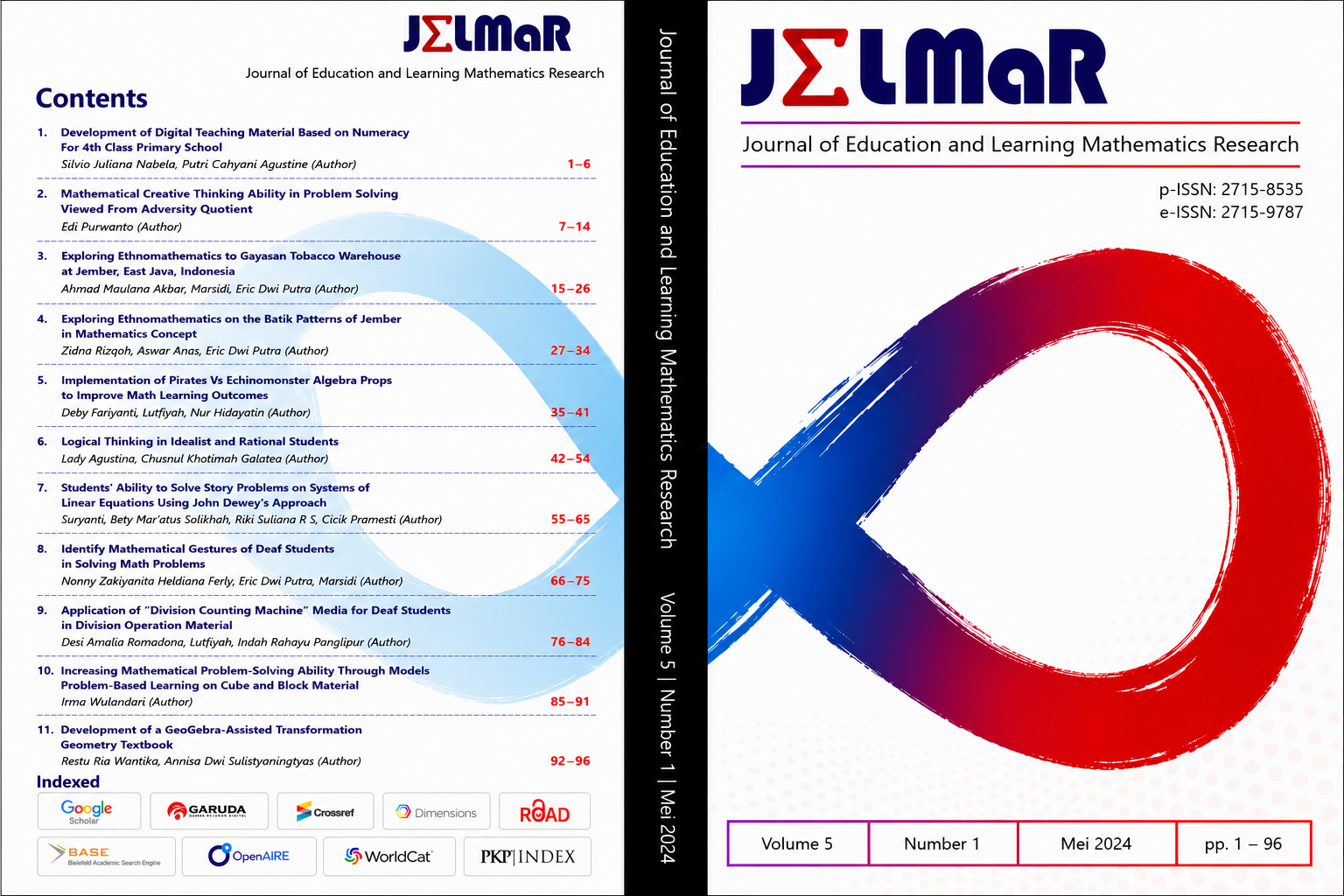
Mathematical Creative Thinking Ability In Problem Solving Viewed From Adversity Quotient
DOI:
https://doi.org/10.37303/jelmar.v5i1.166Keywords:
Mathematical creative thinking, Problem-solving, Adversity quotientAbstract
This qualitative descriptive research aims to analyze the ability to think creatively mathematically
in problem-solving in terms of the adversity quotient. The research was conducted on 10 students of the Mathematics Education Study Program, Faculty of Education, Pawyatan Daha University. Collecting data using questionnaires, tests, interviews, and documentation. Questionnaire to determine the Adversity Quotient scale. A test to measure the ability to think creatively mathematically. Data analysis in the form of induction and reduction theory. The results of the questionnaire showed 3 students (30%) quitters, 6 students (60%) campers, and 1 student (10%) climber. The test showed that 4 students (40%) had high ability, 4 (40%) moderate, and 2 (20%) low. The results of the analysis show that students with the quitter type fulfill the three problem-solving indicators. students of the flexibility criteria with the camper type fulfill all indicators but lack detail, and originality criteria students with the climber type are able to fulfill all problem-solving indicators in detail.
Downloads
References
Astuti, K. M. D., & Setiawan, R. (2017). Analisis strategi menyederhanakan masalah serupa dan sudut pandang lain pada permasalahan nonrutin penjumlahan fungsi. AKSIOMA: Jurnal Program Studi Pendidikan Matematika, 6(1), 56–67.
Fauziah, E. W., Yuliati, N., & Indrawanti, D. (2019). Students' creative thinking skills in mathematical problem posing based on lesson study for the learning community. IOP Conference Series: Earth and Environmental Science, 243(1), Article 012142. https://doi.org/10.1088/1755-1315/243/1/012142
Febriyanti, U. A., Hobri, & Setiawani, S. (2016). Tingkat berpikir kreatif siswa kelas VII dalam menyelesaikan soal open-ended pada subpokok bahasan persegi panjang dan persegi. Jurnal Edukasi, 3(2), 5–8.
Hobri, Suharto, & Naja, A. R. (2018). Analysis of students' creative thinking level in problem solving based on the National Council of Teachers of Mathematics. Journal of Physics: Conference Series, 1008, Article 012065. https://doi.org/10.1088/1742-6596/1008/1/012065
Nahrowi, N., Susanto, & Hobri. (2020). The profile of students' creative thinking skills in mathematics problem solving in terms of adversity quotient. Journal of Physics: Conference Series, 1465, Article 012064. https://doi.org/10.1088/1742-6596/1465/1/012064
Nazareth, E., Romlah, S., Safitri, J., Yuliati, N., Sarimanah, E., Monalisa, L. A., & Harisantoso, J. (2019). Students' creative thinking ability in accomplishing collaborative learning-based open-ended questions. IOP Conference Series: Earth and Environmental Science, 243(1), Article 012145. https://doi.org/10.1088/1755-1315/243/1/012145
Nurlaeli, N., Noornia, A., & Wiraningsih, E. D. (2018). Pengaruh model pembelajaran problem-based learning terhadap kemampuan berpikir kritis matematis siswa ditinjau dari adversity quotient. FIBONACCI: Jurnal Pendidikan Matematika dan Matematika, 4(2), 145–154.
Putra, A. L. T., Dwidayati, N. K., & Isnarto. (2020). Problem-solving ability in terms of adversity quotient on SFE learning based on firing line. Unnes Journal of Mathematics Education Research, 9(1), 78–85.
Ra'is, A., Hobri, & Oktavianingtyas, E. (2018). Berpikir kreatif dalam memecahkan masalah subpokok bahasan segitiga dan segiempat berdasarkan adversity quotient (AQ) siswa kelas VII E SMP Nuris Jember. KadikmA, 9(1), 79–87.
Semiawan, C. R. (2010). Metode penelitian kualitatif: Jenis, karakteristik, dan keunggulannya. Grasindo.
Tohir, M., & Abidin, Z. (2018). Students' creative thinking skills in solving two-dimensional metric series through research-based learning. Journal of Physics: Conference Series, 1008(1), Article 012072. https://doi.org/10.1088/1742-6596/1008/1/012072
Ummah, I. K., & Yuliati, N. (2020). The effect of jumping task based on creative problem solving on students' problem-solving ability. International Journal of Instruction, 13(1), 387–406.
Yanti, A. P., & Syazali, M. (2016). Analisis proses berpikir siswa dalam memecahkan masalah matematika berdasarkan langkah-langkah Bransford dan Stein ditinjau dari adversity quotient. Al-Jabar: Jurnal Pendidikan Matematika, 7(1), 63–74.
Downloads
Published
Issue
Section
License

This work is licensed under a Creative Commons Attribution-ShareAlike 4.0 International License.