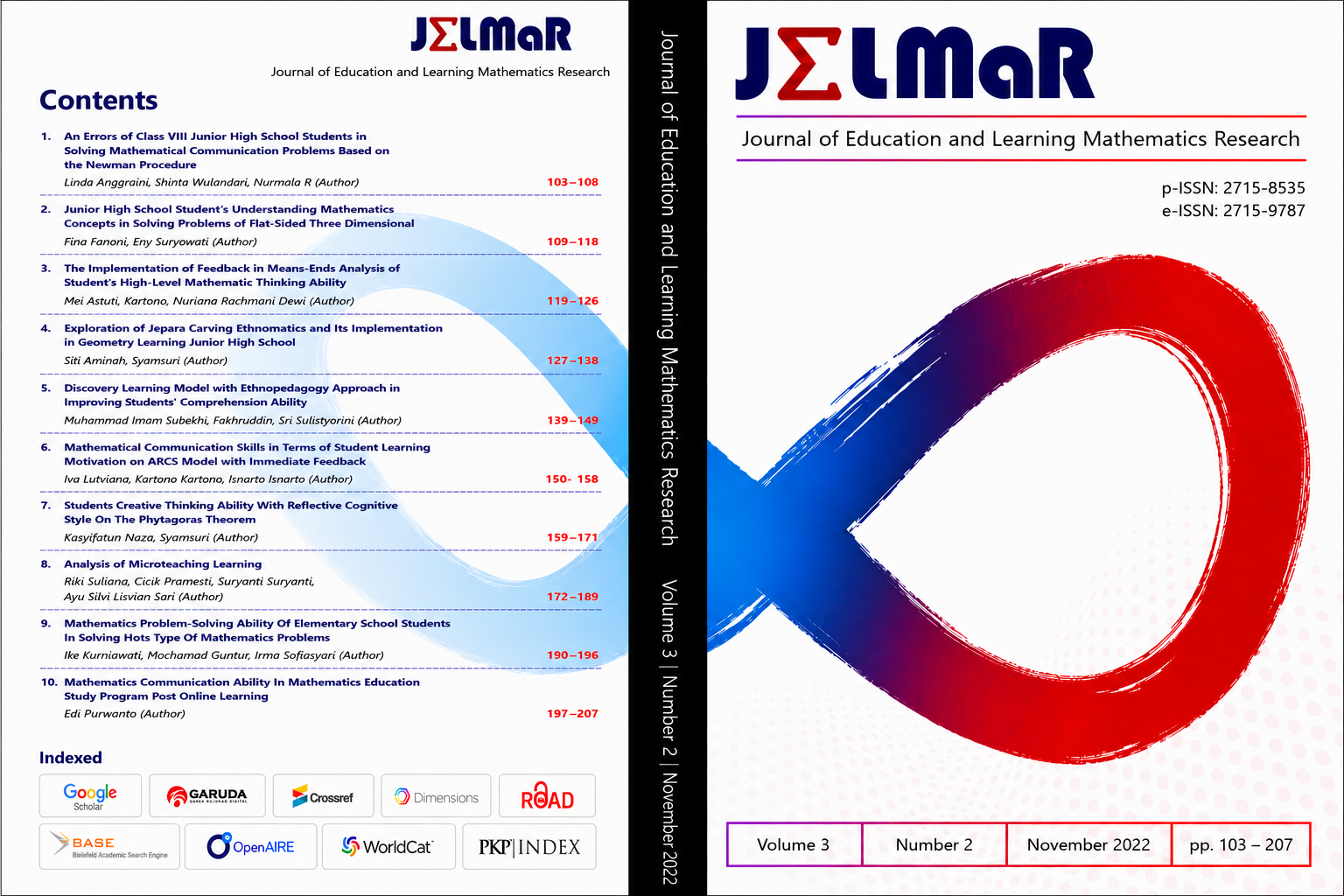
Mathematics Problem-Solving Ability Of Elementary School Students In Solving Hots Type Of Mathematics Problems
DOI:
https://doi.org/10.37303/jelmar.v3i2.135Keywords:
Education Mathematics, HOTS, Problem Solving SkillsAbstract
Students should be trained to solve problems in mathematics so that they can do so in their studies also so that they can solve problems in their everyday lives, especially mathematical ones, with ease. This study aimed to learn how well students in grade five at SDN 26 in Rejang Lebong solved mathematical problems requiring higher-level critical thinking (HOTS). This study is an example of content analysis as a type of qualitative descriptive research. Students from Class 26 at VA SDN SDN in Rejang Lebong comprise the research sample. Testing members are used for data collection. The test questions are five multiple-choice HOTS problems. Research findings demonstrate students' varying abilities to solve arithmetic problems. The students have a good grasp of the issues from the perspective of problem understanding. Students aren't fully utilizing concepts and procedures while analyzing problems and developing solutions with mathematical tools, which is an issue with regard to problem-solving planning. Students have not fully written solutions to problems from both the planning and implementation perspectives, and from the perspective of looking back at previous solutions, they have not written those solutions down either.
Downloads
References
Abdiyani, S. S., Khabibah, S., & Rahmawati, N. D. (2019). Profil kemampuan pemecahan masalah matematika siswa SMP Negeri 1 Jogoroto berdasarkan langkah-langkah Polya ditinjau dari adversity quotient. Al-Khwarizmi: Jurnal Pendidikan Matematika dan Ilmu Pengetahuan Alam, 7(2), 123–134. https://doi.org/10.24256/jpmipa.v7i2.774
Ahmad, J. (2018). Desain penelitian analisis isi (content analysis). UIN Syarif Hidayatullah Jakarta.
Ade Suyitno. (2013). Pengaruh pengetahuan kewirausahaan dan kesiapan instrumen terhadap intensi kewirausahaan (Skripsi/Tesis). Universitas Pendidikan Indonesia.
Ba’diah, U. (2017, 24 Juni). Pentingnya pendidikan matematika. Kompas.
Branca, N. A. (1980). Problem solving as a goal, process, and basic skill. In S. Krulik & R. E. Reys (Eds.), Problem solving in school mathematics: 1980 Yearbook (pp. xx–xx). National Council of Teachers of Mathematics.
Dewi, I. N., Poedjiastoeti, S., & Prahani, B. K. (2017). ElSII learning model based on local wisdom to improve students’ problem-solving skills and scientific communication. International Journal of Education and Research, 5(1), 107–118.
Hidayat, W., & Sariningsih, R. (2018). Kemampuan pemecahan masalah matematis dan adversity quotient siswa SMP melalui pembelajaran open-ended. Jurnal Nasional Pendidikan Matematika (JNPM), 2(1), 109–118.
Holmes, J. (1993). An introduction to sociolinguistics. Longman.
Inayah, S. (2018). Peningkatan kemampuan pemecahan masalah dan representasi multipel matematis dengan menggunakan model pembelajaran kuantum. KALAMATIKA: Jurnal Pendidikan Matematika, 3(1), 1–16. https://doi.org/10.22236/kalamatika.vol3no1.2018pp1-16
Kementerian Pendidikan dan Kebudayaan, Badan Penelitian dan Pengembangan, Pusat Penilaian Pendidikan. (2019). INAP SD. https://puspendik.kemdikbud.go.id/inap-sd/
Mullis, I. V. S., Martin, M. O., Foy, P., & Hooper, M. (2016). TIMSS 2015 international results in mathematics. TIMSS & PIRLS International Study Center, Boston College. http://timssandpirls.bc.edu/timss2015/international-results/
National Council of Teachers of Mathematics. (2000). Principles and standards for school mathematics. National Council of Teachers of Mathematics.
Pratiwi, N. A. (2019). Analisis kemampuan pemecahan masalah matematis siswa SMP melalui soal tes pada materi persamaan linear satu variabel. Dalam Prosiding Seminar Nasional Matematika dan Pendidikan Matematika Sesiomadika 2019 (hlm. 200–207).
Rapih, S., & Sutaryadi. (2018). Perspektif guru sekolah dasar terhadap higher order thinking skills (HOTS): Pemahaman, penerapan, dan hambatan. Premiere Educandum: Jurnal Pendidikan Dasar dan Pembelajaran, 8, 78–87. https://doi.org/10.25273/pe.v8i1.2560
Ruseffendi, E. T. (2006). Pengantar kepada membantu guru mengembangkan kompetensinya dalam pengajaran matematika untuk meningkatkan CBSA. Tarsito.
Sumartini, T. S. (2016). Peningkatan kemampuan pemecahan masalah matematis siswa melalui pembelajaran berbasis masalah. Mosharafa: Jurnal Pendidikan Matematika, 5(2), 148–158. https://doi.org/10.31980/mosharafa.v5i2.270
Widana, I. W. (2017). Modul penyusunan higher order thinking skills (HOTS). Direktorat Pembinaan SMA, Direktorat Jenderal Pendidikan Dasar dan Menengah, Kementerian Pendidikan dan Kebudayaan.
Widyastuti, R. (2015). Proses berpikir siswa dalam menyelesaikan masalah matematika berdasarkan teori Polya ditinjau dari adversity quotient tipe climber. Al-Jabar: Jurnal Pendidikan Matematika, 6(2), 183–193.
Downloads
Published
Issue
Section
License

This work is licensed under a Creative Commons Attribution-ShareAlike 4.0 International License.