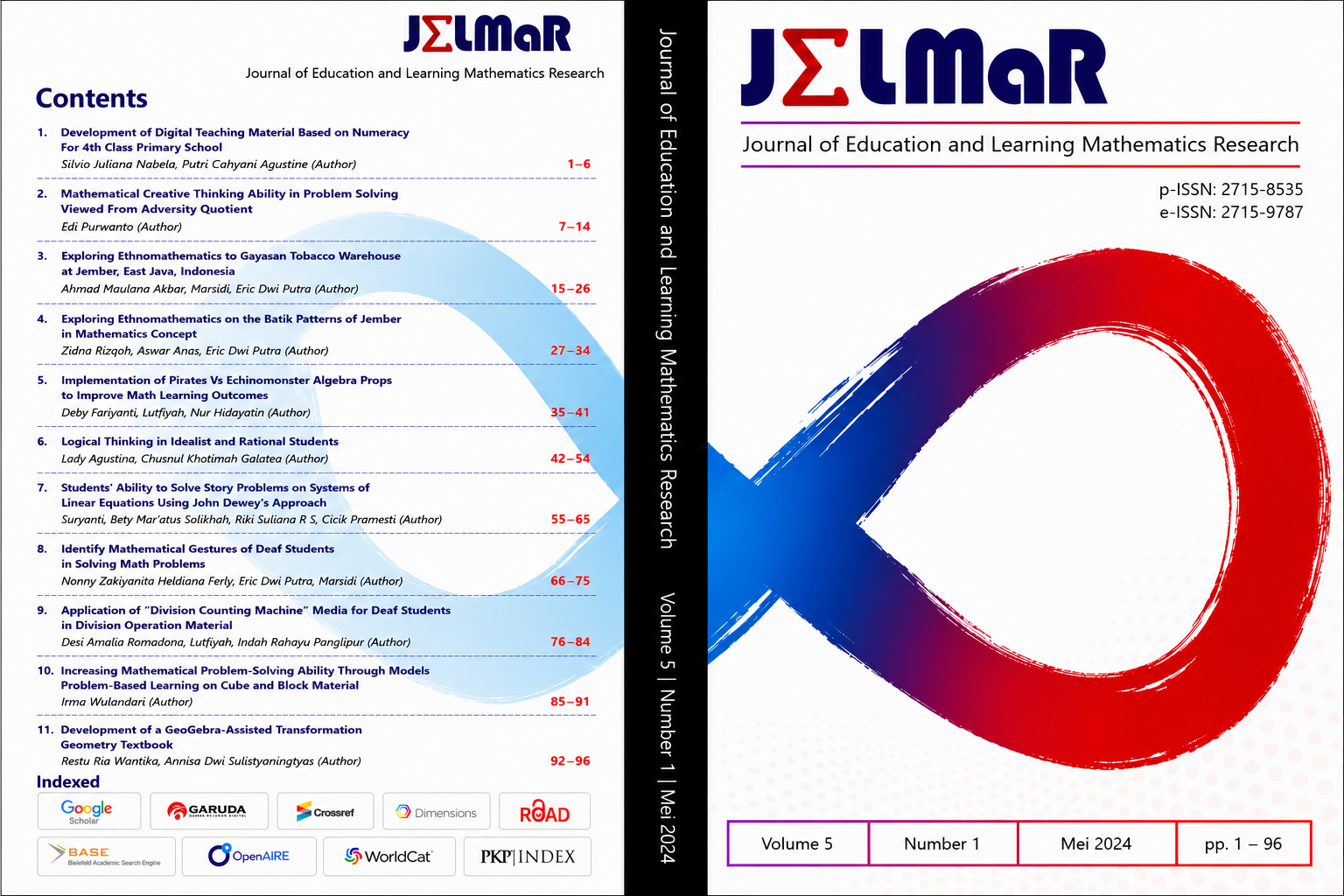
Students' Ability to Solve Story Problems on Systems of Linear Equations Using John Dewey's Approach
DOI:
https://doi.org/10.37303/jelmar.v5i1.172Keywords:
problem solving, story problemAbstract
Students can study everyday mathematics with a story problem. Through this problem, students gain critical thinking experience in solving problems. The ability of students to solve problems through John Dewey's approach is also seen to deepen students' mathematical concepts in three-variable linear equation systems. Problem solving with John Dewey's approach consists of five stages. This method of research uses a qualitative descriptive approach with three persons as the subject of the research, with good, sufficient, and less as the categories of ability. The results of the research showed the subject's ability to solve a story problem with the John Dewey approach. Four given questions showed that the subject with a category of good ability can solve two problems with clear mathematical concepts. Whereas the student with sufficient ability can only solve one problem with an obvious mathematical concept, However, the subject with less ability is only able to solve a problem until the stage of inventorying several solutions, which is the third stage of problem solving with the approach of John Dewey.
Downloads
References
Cahyani, N. P. I., Suarsana, I. M., & Mahayukti, G. A. (2021). Improving students' mathematical problem-solving skills through relating-experiencing-applying-cooperating-transferring learning strategy and graphic organizer. Dalam Proceedings of the First International Conference on Science, Technology, Engineering and Industrial Revolution (ICSTEIR 2020) (Vol. 536, hlm. 337–344). Atlantis Press. https://doi.org/10.2991/assehr.k.210312.056
Căprioară, D. (2015). Problem solving: Purpose and means of learning mathematics in school. Procedia – Social and Behavioral Sciences, 191, 1859–1864. https://doi.org/10.1016/j.sbspro.2015.04.332
Carson, J. (2007). A problem with problem solving: Teaching thinking without teaching knowledge. The Mathematics Educator, 17(2), 7–14.
Chen, N.-C. (2008). An educational approach to problem-based learning. The Kaohsiung Journal of Medical Sciences, 24(3), S23–S30. https://doi.org/10.1016/S1607-551X(08)70090-1
Fauziah, F. A., & Astutik, E. P. (2022). Analisis kesalahan siswa dalam pemecahan masalah soal cerita matematika berdasarkan langkah Polya. Jurnal Cendekia: Jurnal Pendidikan Matematika, 6(1), 996–1007. https://doi.org/10.31004/cendekia.v6i1.1086
Klang, N., Karlsson, N., Kilborn, W., Eriksson, P., & Karlberg, M. (2021). Mathematical problem-solving through cooperative learning: The importance of peer acceptance and friendships. Frontiers in Education, 6, Article 710296. https://doi.org/10.3389/feduc.2021.710296
Marsigit, Retnawati, H., Apino, E., Santoso, R. H., Arlinwibowo, J., Santoso, A., & Rasmuin. (2020). Constructing mathematical concepts through external representations utilizing technology: An implementation in IRT course. TEM Journal, 9(1), 317–326. https://doi.org/10.18421/TEM91-44
Österman, T., & Bråting, K. (2019). Dewey and mathematical practice: Revisiting the distinction between procedural and conceptual knowledge. Journal of Curriculum Studies, 51(4), 457–470. https://doi.org/10.1080/00220272.2019.1594388
Rahmawati, D., & Permata, L. D. (2018). Analisis kesalahan siswa dalam menyelesaikan soal cerita program linear dengan prosedur Newman. Jurnal Elektronik Pembelajaran Matematika, 5(2), 173–185.
Sari, P. P., & Lestari, D. A. (2020). Analisis kesulitan siswa SMP menyelesaikan soal cerita pada materi sistem persamaan linear dua variabel. Jurnal Pendidikan Matematika, 4(1), 286–293.
Sugiyono. (2018). Metode penelitian kualitatif untuk penelitian yang bersifat eksploratif, interpretif, interaktif, dan konstruktif. Alfabeta.
Suharnan. (2005). Psikologi kognitif. Srikandi.
Suryanti, Sari, C. Y., & Kristiani. (2020). Kesalahan penyelesaian soal statistika tipe higher order thinking skills berdasarkan teori Newman. Jurnal Tadris Matematika, 3(2), 207–218. https://doi.org/10.21274/jtm.2020.3.2.207-218
Tello, E. A. (2010). Making mathematics word problems reliable measures of student mathematics abilities. Journal of Mathematics Education, 3(1), 15–26.
Unonongo, P., Ismail, S., & Usman, K. (2021). Analisis kemampuan pemecahan masalah pada materi bangun ruang sisi datar di kelas IX. Jambura Journal of Mathematics Education, 2(2), 43–49. https://doi.org/10.34312/jmathedu.v2i2.10591
Wahyudi, & Anugraheni, I. (2017). Strategi pemecahan masalah matematika (1st ed.). Satya Wacana University Press.
Downloads
Published
Issue
Section
License

This work is licensed under a Creative Commons Attribution-ShareAlike 4.0 International License.